Art has the power to move people-- if art did not there would, in most cases, be no reason to create art in the first place. The visual dialogue that is art is one of the purest forms of communication in my opinion. There are hundreds if not thousands of examples of art that is capable of touching the soul of viewers. For example, viewers have been known to weep while standing before a painting by Mark Rothko-- while others have cried openly before Picasso’s Guernica. Why? Because these works touched them on an inner level.
True, these works can move someone on an emotional level. However, I would say that emotion and the spiritual often mesh. I’m not necessarily talking about the religious aspects of spirituality as much as the fact that many people will describe how a specific image can ‘touch’ them on the inside-- a connection that is often beyond words and expression. These connections are made everyday in art galleries and art museums worldwide.
In many of these examples the viewer has prior knowledge of what the image represents or about the life of the artist-- they may have read about the specific artwork in a book before having ever viewed it in person. In other words, people know that Rothko had a difficult life and that Guernica captures the horror and pain of war. However, even without that knowledge the use of color, figures, and symbolism can have universal implications I would think. You could say that we are born to understand visual images to some degree.
Thus, without knowing one can experience a message-- one that touches the core of how he or she defines himself or herself-- that is just as powerful as the message experienced by an art historian who knows the who, what, and when. To me, that is the power of art-- and the basis of why we feel connected to specific images. In a sense, we can understand an image without fully understanding. Such is life. True?
Consider this an open topic concerning the spiritual aspects of art. Has a specific work of art touched your soul? Can you recall a specific work of art that helped your through a difficult time or defined a time of joy for you? I know that some people suggest that there is no longer room for the spiritual in the art of today-- do you agree? Or would you say that the spiritual aspects of art surround us just as they did in other periods of time? In your opinion, why does visual art have this power-- why do viewers establish these personal connections?
Take care, Stay true,
Brian Sherwin
Senior Editor
myartspace.com
www.myartspace.com
Myartspace Blog on Twitter
www.twitter.com/myartspace_blog
Tuesday, May 26, 2009

Art Space Talk: Carla Falb (Part 3)
 Roller Coaster Series: Nitro by Carla Falb
This is Part 3 of my interview with Carla Falb. To read Part 2 click, HERE
Brian Sherwin: Carla, what are your thoughts concerning the internet and utilizing the World Wide Web in order to gain exposure for your art? In your opinion, why is it important for artists to embrace the Internet?
Carla Falb: When I began making art, in order to gain exposure, we had to take slides, which meant: hanging a black backdrop on the wall, lighting the work so there would be no glare, bracketing the shots, finding a studio that would process slide film, then selecting the best slides to have duplicates made. After making the slides we would need to label them – either with fine tipped Sharpies or clear address labels cut to size, and then finally mail our information out to galleries and competitions. So much has changed in so little time!
Carla Falb: When I began making art, in order to gain exposure, we had to take slides, which meant: hanging a black backdrop on the wall, lighting the work so there would be no glare, bracketing the shots, finding a studio that would process slide film, then selecting the best slides to have duplicates made. After making the slides we would need to label them – either with fine tipped Sharpies or clear address labels cut to size, and then finally mail our information out to galleries and competitions. So much has changed in so little time!
Now with digital photography and the opportunity to post our work on sites like My Art Space – the world has opened up for artists. People from all over the world have the opportunity to view our work! Through My Art Space, we can connect with other artists that have similar interests. I also know that I don’t feel nearly so isolated with my art making as when I wasn’t connected to the World Wide Web. I have a sense that people are interested in my work and want to see more.
BS: Will you be involved with any upcoming exhibits?
CF: As a matter of fact, I happy to say that I was just selected as one of twenty artists that will be exhibiting their work in the Spring Exhibition at the NYAXE Gallery in Palo Alto, California. Selected drawings and paintings from my Roller Coaster Series will be displayed digitally.
BS: Will you be involved with any upcoming exhibits?
CF: As a matter of fact, I happy to say that I was just selected as one of twenty artists that will be exhibiting their work in the Spring Exhibition at the NYAXE Gallery in Palo Alto, California. Selected drawings and paintings from my Roller Coaster Series will be displayed digitally.
 Roller Coaster Series: Viper Triptych by Carla Falb
BS: There has been several stories involving copyright infringement in the mainstream press as of late. What is your stance on copyright? Do you see strong copyright as a reflection of artist rights in general? Or do you feel that copyright restricts creativity? Do you have a stance on this issue?
CF: When I decided that I wanted to use roller coaster structures in my artwork, it occurred to me that I could just use images that I would be able to find online and in published books. However, even if I combined and transformed the images to make them my own, to get around the copyright laws, it simply felt unethical and phony – like trying to pass off someone else’s experiences as my own.
CF: When I decided that I wanted to use roller coaster structures in my artwork, it occurred to me that I could just use images that I would be able to find online and in published books. However, even if I combined and transformed the images to make them my own, to get around the copyright laws, it simply felt unethical and phony – like trying to pass off someone else’s experiences as my own.
In addition, I decided that perhaps most importantly, I wanted viewers to have a visceral reaction when looking at my work – to actually feel as if they are on an endless ride. I realized that if I wanted to create this experience for my viewers, I would have to go to amusement parks, wait in line, ride the coasters, sit in the front car, and take my own photos – an industrialized/pop version of J. M. W. Turner’s habit of riding out storms at sea.
On the other hand, what about work that is about the mass media and our popular culture? Can you imagine if Andy Warhol hadn’t deliberately used copyrighted photos? His famous image of Marilyn Monroe was originally a publicity shot by Gene Korman for the film Niagara, made in 1953. Did Shepard Fairey do anything that different from Warhol when he used an Associated Press photo as a basis for his recent “Hope” portrait of President Obama? The following link is to a Washington Times article explaining the suits and counter-suits between Fairey and the Associated Press:
www.washingtontimes.com/news/2009/mar/12/iconic-obama-hope-portrait-hung-up-in-court/
When considering the question of copyright infringement, it’s also essential to look at the work of contemporary representational painter, Damian Loeb, who uses movie stills as source material. At the beginning of his career he was involved in several lawsuits because of his use of copyrighted images. Currently he is considered one of the preeminent Post-Modern representational painters and is represented by the prestigious Acquavella Gallery in New York.
When considering the question of copyright infringement, it’s also essential to look at the work of contemporary representational painter, Damian Loeb, who uses movie stills as source material. At the beginning of his career he was involved in several lawsuits because of his use of copyrighted images. Currently he is considered one of the preeminent Post-Modern representational painters and is represented by the prestigious Acquavella Gallery in New York.
There is an excellent article on Loeb’s website by Charles Giuliano that mentions the suits and describes Loeb’s commitment to film as a resource for his paintings:
On the Acquavella website Loeb explains his choice of using images from films: www.acquavellagalleries.com/artists/damian-loeb/
Do I have a stance on these copyright issues? I imagine the simple answer is that it depends on the artists’ intent. I agree with Shepard Fairey when he explains that artists’ use photos of public figures for “reference as a part of social commentary should not be stifled.” When copying serves a higher purpose, it seems ethical, and in some cases, essential to the meaning of an artists’ work.
 Roller Coaster Series: Medusa by Carla Falb
BS: As you know, the economy has been hard. Have you had to change-- or should I say adapt-- your practice due to the economy?
CF: Actually, the economy has always been an issue for me. Rather than placing my career as a painter first, I’ve been teaching in public schools for twenty-two years to earn a steady income and that job has always come first as far as prioritizing my time. As a consequence, most of my artwork has been accomplished over the summer. On a positive note, my work with students gives me so much fulfillment and joy; it has played a huge role defining my identity and giving my life purpose.
BS: Finally, is there anything else you would like to say about your art?
CF: Look for some new work this fall on My Art Space and on my website: www.carlafalb.com. I plan on having a productive summer!
CF: Actually, the economy has always been an issue for me. Rather than placing my career as a painter first, I’ve been teaching in public schools for twenty-two years to earn a steady income and that job has always come first as far as prioritizing my time. As a consequence, most of my artwork has been accomplished over the summer. On a positive note, my work with students gives me so much fulfillment and joy; it has played a huge role defining my identity and giving my life purpose.
BS: Finally, is there anything else you would like to say about your art?
CF: Look for some new work this fall on My Art Space and on my website: www.carlafalb.com. I plan on having a productive summer!
This concludes my interview with Carla Falb. To return to Part 1 click, HERE
Take care, Stay true,
Brian Sherwin
Senior Editor
myartspace.com
www.myartspace.com
Myartspace Blog on Twitter
www.twitter.com/myartspace_blog
Brian Sherwin
Senior Editor
myartspace.com
www.myartspace.com
Myartspace Blog on Twitter
www.twitter.com/myartspace_blog
Art Space Talk: Carla Falb (Part 2)
 Roller Coaster Series: Statosphere by Carla Falb
This is Part 2 of my interview with Carla Falb. To read Part 1 click, HERE
Brian Sherwin: Carla, what about other influences? For example, are you influenced by any specific artists?
Carla Falb: The idea of combining roller coaster tracks from various viewpoints in a single composition is derived from Cubism. In Gertrude Stein’s words, I am attempting to create a world where there “There is no there, there.” This notion can also be likened to Einstein’s imagining that he could travel on a beam of light where space contracts, time dilates, and now enlarges to encompass the past and the present.
Carla Falb: The idea of combining roller coaster tracks from various viewpoints in a single composition is derived from Cubism. In Gertrude Stein’s words, I am attempting to create a world where there “There is no there, there.” This notion can also be likened to Einstein’s imagining that he could travel on a beam of light where space contracts, time dilates, and now enlarges to encompass the past and the present.
The Futurists were also interested in creating this experience of simultaneity in their work while using imagery that glorified technological advancements, speed, youth, and violence. My subject matter certainly seems to fits the Futurists’ iconography, and simulates the experience of traveling the length of the roller coaster in a single instant. However, being a Post-Modernist, I use the imagery of the rides with a sense of irony and wonder of the need to experience extreme thrills and fear as a recreation in our twenty-first century pop culture.
In graduate school, during the summer of 2001 when I was just beginning my series, I saw two exhibits that would profoundly influence my work: Wayne Theibaud’s retrospective at the Whitney, and architect Frank Gehry’s models and sketches at the Guggenheim. Prior to viewing these exhibits, I always considered constructed/man-made forms and natural forms to be diametrically opposed.
In graduate school, during the summer of 2001 when I was just beginning my series, I saw two exhibits that would profoundly influence my work: Wayne Theibaud’s retrospective at the Whitney, and architect Frank Gehry’s models and sketches at the Guggenheim. Prior to viewing these exhibits, I always considered constructed/man-made forms and natural forms to be diametrically opposed.
When I saw Gehry’s spiraling wave/shell-like buildings and Theibaud’s plummeting waterfall San Francisco streets, I realized that natural and constructed forms could be melded. My roller coaster tracks could become strands of DNA, circulatory systems, explorations of time and space, wormholes, and universes. In addition, partly because of Theibaud’s influence, I enjoy employing roller coaster imagery in my work so that it can be appreciated on a variety of levels: by the general public, young and old, as well as the art world.
BS: So what is the specific message you strive to convey to viewers? Do you adhere to a specific philosophy as far as your work is concerned?
CF: In Meyer Schapiro’s essay, “On Perfection, Coherence, and Unity of Form and Content,” the concept of unity in a work of art is likened to the “mystic’s experience of the oneness of the world or with God.” What does this have to do with roller coasters? Certainly on a formal level, I focus on uniting my compositions through use of color and repetition of forms. But the question remains, how can spiritual awe and the thrill of amusement rides be compared when they are on entirely different planes of existence? Perhaps like the process of art making itself, each is associated with a need to transcend the mundane experience of everyday reality.
A critic once described my roller coaster drawings as twenty-first century versions of M. C. Escher’s work. After hearing this, I did some research on Escher and found that his complex black and white prints are influenced by an unlikely combination of Mathematics, Cubism, Futurism, Surrealism, and Eastern philosophy. According to Leonard Shlain in Art and Physics, Escher’s depictions of Mobius strips in several of his works vividly illustrate the Chinese concept of Tao. On the site, www.thetao.info, Robert Friedler states that “common dictionary translations of Tao include: road, path, way, means, doctrine.
BS: So what is the specific message you strive to convey to viewers? Do you adhere to a specific philosophy as far as your work is concerned?
CF: In Meyer Schapiro’s essay, “On Perfection, Coherence, and Unity of Form and Content,” the concept of unity in a work of art is likened to the “mystic’s experience of the oneness of the world or with God.” What does this have to do with roller coasters? Certainly on a formal level, I focus on uniting my compositions through use of color and repetition of forms. But the question remains, how can spiritual awe and the thrill of amusement rides be compared when they are on entirely different planes of existence? Perhaps like the process of art making itself, each is associated with a need to transcend the mundane experience of everyday reality.
A critic once described my roller coaster drawings as twenty-first century versions of M. C. Escher’s work. After hearing this, I did some research on Escher and found that his complex black and white prints are influenced by an unlikely combination of Mathematics, Cubism, Futurism, Surrealism, and Eastern philosophy. According to Leonard Shlain in Art and Physics, Escher’s depictions of Mobius strips in several of his works vividly illustrate the Chinese concept of Tao. On the site, www.thetao.info, Robert Friedler states that “common dictionary translations of Tao include: road, path, way, means, doctrine.
In the Tao Tee Ching, it is generally used to indicate the unseen, underlying law of the universe from which all other principles and phenomena proceed.” Roller coaster tracks can be viewed as pathways and equated to a complex Mobius strip, since at the end of the ride, the cars arrive back where they began. This cyclical law of the universe, where opposing forces are unified, is the philosophical core of my work.
 Roller Coaster Series: New York, New York by Carla Falb
BS: What are you working on at this time? Can you give our readers some insight into your current work?
CF: I recently received a Dodge Foundation Visual Artist/ Educator Fellowship and will use part of the funds to travel to Los Angeles this summer to photograph roller coasters and various amusements at Tomorrowland in Disneyland, Knotts Berry Farm, and the Santa Monica Pier. When thinking about the next progression in my Roller Coaster Series, I considered that even though I have always lived on the East Coast, the imagery in my Roller Coaster Series has more of a West Coast/ pop culture vibe. So I decided that LA would be an ideal location to gather new source material for paintings.
I’m looking forward to being taken by surprise by the unexpected amusements or images I will encounter, not just the rides I’ve viewed online. I’m also interested in photographing the parks at night. This is something I have never tried before, and I think I might like the disorienting effects of the colorful lights and the blurred motion.
To read Part 3 of my interview with Carla Falb click, HERE
Take care, Stay true,
Brian Sherwin
Senior Editor
myartspace.com
www.myartspace.com
Myartspace Blog on Twitter
www.twitter.com/myartspace_blog
Art Space Talk: Carla Falb (Part 1)
Don’t be mistaken by Carla Falb’s art. Falb is not a roller coaster fanatic and doesn't consider her work as literally depicting specific rides. Instead, Falb thinks of her Roller Coaster Series as being more about the layers of metaphorical meanings based on the various coasters' physical structures, sudden turns, extreme drops, and cyclical ride. Falb was recently selected for representation at the NYAXE Gallery in Palo Alto, CA. NYAXE Gallery is operated by Catherine McCormack-Skiba-- the founder of www.myartspace.com and www.nyaxe.com.
 Roller Coaster Series: Medusa Storm by Carla Falb
Brian Sherwin: Carla, tell us about yourself. At what point did you gain an interest in creating visual art?
Carla Falb: In junior high I was deeply involved in music. At home I spent hours practicing classical piano and even auditioned to play with the Philadelphia Orchestra. When I got to high school, my piano teacher emphatically explained that I needed to decide if I wanted to make a commitment to become a concert pianist.
At the time, I was searching for a more creative outlet, so I decided not to continue with music, and began to take classes in visual arts. By my junior year I decided that I wanted to be a painter, applied for early admission, and was accepted to the Philadelphia College of Art at age sixteen.
BS: What can you tell us about your academic background concerning art? Did you study art formally? Tell us about your art studies in general-- any influential instructors?
CF: After spending three semesters at the Philadelphia College of Art (PCA), I realized that I wanted to learn traditional painting techniques, so I began studying at the Pennsylvania Academy of Fine Arts – the oldest art school in the United States. Looking back, I realize that since I was a classically trained musician; it made sense that I desired a more formal approach to painting.
While at the Academy, my most influential instructors were Arthur DeCosta, and Sidney Goodman. DeCosta’s demonstrations in Basic Color class focused on understanding the history of various palettes as well as skill development of alla prima painting techniques. His classes were engaging and informative. On the other hand, Goodman’s classes were intense. On the days he instructed, we were given the task to complete an entire figure painting in three hours.
I now see my undergraduate education as being the best of both worlds. At PCA I received a solid background in design and composition, and the Academy developed my formal/ technical skills. Today as a fine arts teacher in high school, I bring both of these approaches to my classroom instruction. Roller Coaster Series: Circus Circus by Carla Falb
BS: Can you tell us about your art? Give us some insight into the thoughts behind your art.
CF: When I decided to focus on the visual arts back in high school, my choice was driven by a strong desire to work in a tangible medium where I could further my quest for self-knowledge. Later, in graduate school, before I came up with the idea for my Roller Coaster Series, I deliberated about who I was as an artist and as a person: what could I paint that truly expressed my personality, energy, and philosophy? Without a particularly interesting ethnic background to explore, and with no strong activist leanings, what unique vision I could share with the world?
After some soul searching I realized that the person who had the most profound effect on my life was my father, a Methodist minister. He shared his beliefs as well as his eclectic interests with me: i.e. the writings of Carl Jung and Herman Hesse, the humor of Charles Addams, and music ranging from Beethoven to the Beatles.
Overall, I see the work I produce as a metaphysical journey that connects the complexities of our physical existence with the emotional/spiritual realm – albeit from a pop-culture perspective. Simply stated, I’m trying to paint the visual equivalent of rock and roll. Summers spent at the Jersey shore and my quirky sense of humor lead me to use roller coaster tracks as means to create movement and depth in my compositions -- to take the viewer on a ride. However, underlying the general euphoria is the unsettling absurdity of the controlled-fear catharsis inherent in thrill rides coexisting with the sense of transcendentalism in my work.
 Roller Coaster Series: Batman by Carla Falb
BS: Can you discuss your process in general? Are there any specific techniques that you utilize?
CF: When I first began my series, I would construct compositions by making collages of Xeroxed photos of roller coasters. Now, I use Photo Shop and have found that even though the physical process has changed, the creative process is similar. Since I usually don’t have a firm idea of what I want when I begin a new work, I play with juxtapositions of the segmented forms – sections of tracks plummeting downward, spiraling and looping through space; lattice/leg-like supports; bits of ground with pathways, blurred buildings and trees; and pieces of sky.
As I am assembling the collages I feel as if I am finding my way through a maze. I want the tracks to travel effortlessly through space and appear as a never-ending ride –using perspective and shifts in scale; yet also have areas of incongruity and disjointedness when examined closely.
To read Part 2 of my interview with Carla Falb click, HERE
Take care, Stay true,
Brian Sherwin
Senior Editor
myartspace.com
www.myartspace.com
Myartspace Blog on Twitter
www.twitter.com/myartspace_blog
Monday, May 25, 2009
Tony Cragg at Galerie Thaddaeus Ropac
 Outspan by Tony Cragg
Galerie Thaddaeus Ropac is currently featuring a collection of sculptures and drawings by sculptor Tony Cragg. The exhibition, which involves three floors of the Ropac space, involves new works in bronze, stone, stainless wood and polished stained steel. Cragg’s drawings explore his ideas concerning form-- specifically how new forms can emerge from landscapes and figures. Tony Cragg won the Turner Prize in 1988. The Tony Cragg exhibit will come to a close on June 13th, 2009.For more information visit, www.ropac.net
Friday, May 22, 2009
Art Space Talk: Jimmy Wales (Part 2)
Brian Sherwin: Wikipedia has been criticized for lack of art coverage. For example, Jonathan Jones of The Guardian suggests that a lot of the amassed art knowledge that can be found on Wikipedia lacks passion and basic understanding of art-- he goes as far as to say that articles about art on Wikipedia are "dull".
Jones has stated that “Art is not science”-- going on to say, “the "facts" about art don't take you very far. Knowing what date Goya died doesn't mean very much if you can't enter the emotional world of his paintings.”. In other words, Jones feels that Wikipedia contributors forget-- possibly due to policy-- to inject meaning in the art articles they contribute to.
Jones used the Wikipedia bio about Goya as an example, stating, “The Wikipedia entry just goes through his life in this flat, unemphatic way, because it wants so desperately to seem serious and knowledgeable. In reality, this approach can disguise ignorance and, worse, deliver misinformation.”. What are you thoughts on Jones opinion? In your opinion, what should Jones and other critics consider when thinking about Wikipedia as a whole?
Jimmy Wales: I don't think our rules prohibit nor inhibit lively and interesting writing about artists or anything else for that matter. It is true that we don't always accomplish it, and I think everyone who writes Wikipedia in a serious way wishes and works to be interesting to the reader. Sometimes we fail, of course. And sometimes we succeed.
It may be true that some raw 'facts' about art don't take you very far. And it is true that to help our readers understand Goya, we need to help the reader "enter the emotional world of his paintings". But that shouldn't relieve us in any way of the responsibility of being factual, of citing good sources, of not substituting random opinion of any arbitrary passerby for actual good encyclopedic writing.
BS: Other art critics have had a more positive or neutral view of Wikipedia. For example, notable art critic Jerry Saltz once said at a CAA panel that, "We live in a Wikipedia art world.“ followed by, “Twenty years ago, there were only four to five encyclopedias--and I tried to get into them. Now, all writing is in the Wikipedia. Some entries are bogus, some are the best. We live in an open art world." What are your thoughts on Jerry Saltz’s viewpoint? Would you say that due to Wikipedia the art world is now more open than in the past-- at least as far as information is concerned?
JW: Well, I hope so. I agree completely with what he says about some entries being bogus, and some being the best. That's a nice way to put it.
BS: That said, is it a goal of Wikipedia to bypass the traditional ‘gatekeepers’ of information? For example, an artist may not be reviewed by an influential art critic-- he or she may not be notable within the mainstream art world itself, but he or she can still be considered notable on Wikipedia and technically have the same standing-- as far as information is concerned-- as artists who have traditionally been accepted by art critics. What are your thoughts on that?
JW: Well, in fact, Wikipedia and Wikipedians tend to be quite conservative and old-fashioned (in some ways) about notability, and quite liberal and progressive (in some other ways). We're able to find "notability" in lots of different places and for lots of different reasons.
An artist who works in commercial anime might be completely ignored by the academic art world, but adored in anime circles, and end up with lots of magazine articles about himself and an entry in Wikipedia that treats him - quite properly - as an artist of some public standing and interest. That seems fine.
But I should clarify that I don't think it is a 'goal' of Wikipedia to bypass traditional gatekeepers, and in some ways, of course, we can be perhaps criticized for empowering them too much. It's a complex question, again, and I think there are often no easy answers.
BS: Finally, do you have anything else say about Wikipedia and art in general?
JW: I suppose my greatest hope is that Wikipedia can, in some small ways, help to get the public started in art appreciation and education. Toward that end, entries about art and artists in Wikipedia should be high quality, well-sourced, and lively.
My hope is that if someone comes for some reason (school, personal interest, accidental clicking) to the entry on Picasso (for example), that they find themselves 2 hours later exploring some much less famous artist or art, or learning about particular schools of thought in art criticism, or reading about techniques in painting, or.. or... or...
Life is about knowledge and exploration. I hope that we are a cherished place for people to do that.
This is Part 2 of my interview with Jimmy Wales. To return to Part 1 click, HERE
To read more interviews visit, www.myartspace.com/interviews
Take care, Stay true,
Brian Sherwin
Senior Editor
myartspace.com
www.myartspace.com
Myartspace Blog on Twitter
www.twitter.com/myartspace_blog
Jones has stated that “Art is not science”-- going on to say, “the "facts" about art don't take you very far. Knowing what date Goya died doesn't mean very much if you can't enter the emotional world of his paintings.”. In other words, Jones feels that Wikipedia contributors forget-- possibly due to policy-- to inject meaning in the art articles they contribute to.
Jones used the Wikipedia bio about Goya as an example, stating, “The Wikipedia entry just goes through his life in this flat, unemphatic way, because it wants so desperately to seem serious and knowledgeable. In reality, this approach can disguise ignorance and, worse, deliver misinformation.”. What are you thoughts on Jones opinion? In your opinion, what should Jones and other critics consider when thinking about Wikipedia as a whole?
Jimmy Wales: I don't think our rules prohibit nor inhibit lively and interesting writing about artists or anything else for that matter. It is true that we don't always accomplish it, and I think everyone who writes Wikipedia in a serious way wishes and works to be interesting to the reader. Sometimes we fail, of course. And sometimes we succeed.
It may be true that some raw 'facts' about art don't take you very far. And it is true that to help our readers understand Goya, we need to help the reader "enter the emotional world of his paintings". But that shouldn't relieve us in any way of the responsibility of being factual, of citing good sources, of not substituting random opinion of any arbitrary passerby for actual good encyclopedic writing.
BS: Other art critics have had a more positive or neutral view of Wikipedia. For example, notable art critic Jerry Saltz once said at a CAA panel that, "We live in a Wikipedia art world.“ followed by, “Twenty years ago, there were only four to five encyclopedias--and I tried to get into them. Now, all writing is in the Wikipedia. Some entries are bogus, some are the best. We live in an open art world." What are your thoughts on Jerry Saltz’s viewpoint? Would you say that due to Wikipedia the art world is now more open than in the past-- at least as far as information is concerned?
JW: Well, I hope so. I agree completely with what he says about some entries being bogus, and some being the best. That's a nice way to put it.
BS: That said, is it a goal of Wikipedia to bypass the traditional ‘gatekeepers’ of information? For example, an artist may not be reviewed by an influential art critic-- he or she may not be notable within the mainstream art world itself, but he or she can still be considered notable on Wikipedia and technically have the same standing-- as far as information is concerned-- as artists who have traditionally been accepted by art critics. What are your thoughts on that?
JW: Well, in fact, Wikipedia and Wikipedians tend to be quite conservative and old-fashioned (in some ways) about notability, and quite liberal and progressive (in some other ways). We're able to find "notability" in lots of different places and for lots of different reasons.
An artist who works in commercial anime might be completely ignored by the academic art world, but adored in anime circles, and end up with lots of magazine articles about himself and an entry in Wikipedia that treats him - quite properly - as an artist of some public standing and interest. That seems fine.
But I should clarify that I don't think it is a 'goal' of Wikipedia to bypass traditional gatekeepers, and in some ways, of course, we can be perhaps criticized for empowering them too much. It's a complex question, again, and I think there are often no easy answers.
BS: Finally, do you have anything else say about Wikipedia and art in general?
JW: I suppose my greatest hope is that Wikipedia can, in some small ways, help to get the public started in art appreciation and education. Toward that end, entries about art and artists in Wikipedia should be high quality, well-sourced, and lively.
My hope is that if someone comes for some reason (school, personal interest, accidental clicking) to the entry on Picasso (for example), that they find themselves 2 hours later exploring some much less famous artist or art, or learning about particular schools of thought in art criticism, or reading about techniques in painting, or.. or... or...
Life is about knowledge and exploration. I hope that we are a cherished place for people to do that.
This is Part 2 of my interview with Jimmy Wales. To return to Part 1 click, HERE
To read more interviews visit, www.myartspace.com/interviews
Take care, Stay true,
Brian Sherwin
Senior Editor
myartspace.com
www.myartspace.com
Myartspace Blog on Twitter
www.twitter.com/myartspace_blog
Art Space Talk: Jimmy Wales (Part 1)
 According to Wikipedia Jimmy Donal “Jimbo” Wales is an American Internet entrepreneur and co-founder and promoter of Wikipedia. I recently contacted Jimmy after reporting on an art project controversy involving Wikipedia. As readers know, I try to keep things fair and balanced. Thus, I wanted to give Wales a chance to share his thoughts on Wikipedia, art, and the concept of notability as far as visual art is concerned.
Brian Sherwin: Mr. Wales, as you know this interview will focus on art. Thus, I think it would be good to start out with some general info about your opinion of art in general. You identify yourself as an Objectivist-- with that in mind, how is the philosophy that you adhere to reflected by the art that you personally enjoy? My understanding is that you are very supportive of the arts community in general. Would you like to discuss that?
Jimmy Wales: I enjoy a wide variety of art, and I don't think it's particularly easy to answer your question without a great deal of introspection on the point, and I've not really undertaken that in any systematic way.
Having given that caveat, though, I can say that there is art that I personally enjoy for a variety of reasons - sometimes because it presents a heroic vision of life, but other times because it presents a disturbing or frightening image of life - but in an intelligent way.
I suppose I can say that the common denominator for art that I admire is: intelligence.
BS: Wikipedia has shown support for visual art by establishing a Wikipedia project titled Wikipedia Loves Art. My understanding is that Wikipedia Loves Art will take place each year in February. Can you discuss the project and your involvement with it? It will be an annual event, correct?
JW: I'm not sure if it will be annual or not - I wasn't directly involved in the organization of it, and I don't know what the organizers are planning. I understand that there is now a version of the event taking place later this year in the Netherlands. Exciting stuff!
Let me get on my soapbox a bit, and in a way that I can be gentler about than I used to be. Museums should welcome the Wikipedia community because we serve a major role in bringing art to everyone in a way that will drive interest in sustaining and protecting art in the long run.
Some museums in the past have presented a rather "proprietary" view of artwork in their museums - even art that has long since passed out of copyright. I don't think they do themselves a service in that attitude, and I'm thrilled to see how many museums are coming around to the opposite view - that the best way to promote art is not to control the distribution of information about art, but to join and support the global conversation about art.
BS: Are there plans for other art-specific Wikipedia projects that are endorsed by you?
JW: I think that Wikipedia's coverage of the arts can and should be improved. It's pretty good in some ways, and not as good in other ways. We have gaps in coverage. We have uneven quality.
The community engages in lots of "Wikiprojects" around all kinds of things. This is a good thing and I'm happy about it.
BS: Concerning artist bios on Wikipedia-- in your opinion, what makes a visual artist notable? Often it is assumed-- based on the deletion debates I’ve viewed-- that an artist is simply seeking free promotional exposure by having a bio created on the site. That said, it would be helpful to know in your own words what makes a visual artist “notable” for inclusion on Wikipedia.
JW: I'm probably not the right person to ask, since I don't get directly involved in such debates. But I'm sure many people can understand the complex dilemma that the community faces. There are no easy answers here.
The fact is, there do exist people - not just artists, obviously, and in fact, I doubt if it is a very big problem with artists as compared to some other professions - who would like to use Wikipedia as a self-promotional platform. But that's not what we're here for, really.
We have to contend with potential hoaxes, with puff-piece bios that have false or inflated claims - this sort of nonsense is routinely handled by the community. And the primary way we do it is through reference to quality third-party sources. What counts as a quality third-party source is going to depend on the context. The rules should be as simple as they can be, of course. But also, no simpler.
This is Part 1 of my interview with Jimmy Wales. To read Part 2 click, HERE
To read more interviews visit, www.myartspace.com/interviews
Take care, Stay true,
Brian Sherwin
Senior Editor
myartspace.com
www.myartspace.com
Myartspace Blog on Twitter
www.twitter.com/myartspace_blog
Thursday, May 21, 2009
George Condo: The Lost Civilization at Musee Maillol
 ‘Father and Son’ by George Condo
The Musee Maillol in Paris is currently featuring the work of George Condo. The exhibit, titled ‘The Lost Civilization’, is part of a series of exhibits that focus on American painters. Over 100 works of art by George Condo are on display.
George Condo has an impressive exhibition history. For example, Condo’s work has been exhibited at the Whitney Museum in New York, the Museum of Modern Art in New York, and the at the Tate Modern. Condo emerged within the same timeframe as Jean-Michel Basquiat, Keith Haring, and other American artists of note.
The exhibit comes to a close on August 17th, 2009. For more information visit, www.museemaillol.com
Wednesday, May 20, 2009
Tony Fitzpatrick's "Big Rock Candy Mountain"
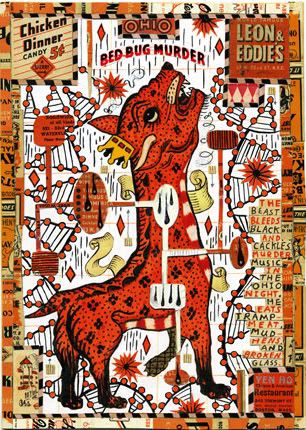
Tony Fitzpatrick
"The Orange Beast"
2009
Drawing and collage
10.5 x 7.5 inches
The Chicago-based artist and poet Tony Fitzpatrick participated in Dieu Donne Papermill's 2006 Lab Grant Residency. "Big Rock Candy Mountain," an outstanding exhibition of the collages Fitzpatrick produced during his Lab Grant term, is currently on display in Dieu Donne's exhibition space.
Fitzpatrick's collages incorporate text, print advertisements, handmade paper and drawings. In medium and manner, Fitzpatrick's collages are more coarse relatives of Fred Tomaselli's beautiful resin works. Tomaselli's pictures are dominated by images from nature and evoke the rarified realm of etherial contemplation and transcendental yearning. Although Fitzpatrick's pictures are similarly sacramental, his iconography is wide-ranging and kitsch, drawing principally from post-war suburban and urban culture. His works are as informed by the American taste for consumer ephemera as they are by Calvinist, fire-and-brimstone theology and old-fashioned hard luck. If Tomaselli's works are the ecstatic offerings of a universalistic mystic, Fitzpatrick's are the esoteric assemblages of a struggling hermit poet; his striking collages might be pulled from a latter-day illuminated manuscript.
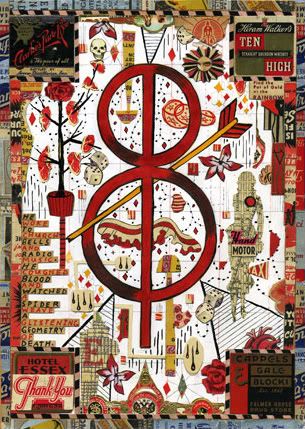
Tony Fitzpatrick
"The Red Road"
2009
Drawing and collage
7.5 x 10.5 inches
Like his imagery, the poetic texts that Fitzpatrick pastes into his collages speak to complex, even contradictory impulses. They are at once banging proclamations and maudlin laments. Consider the text from "Coal City Cock Fighter."
"It is the cock, hobbled and bled to black ash, walking dizzy narcotic, circles among dead birds and cigarette butts. He looks in the Devil's eyes and is homicidally radiant."The press release describes Fitzpatrick's works as "visual poems, reflecting on matters of place, history, and sense of being." The "place [and] history" of Fitzpatrick's imagery are specific to America. His collages are nuanced portraits of the schizophrenic exuberance and religious sensibility that informed American perspectives in the middle of the 20th century (and that generally continue to shape our politics and character in the post-millennial world).
"Big Rock Candy Mountain" closes this Friday, May 22nd.
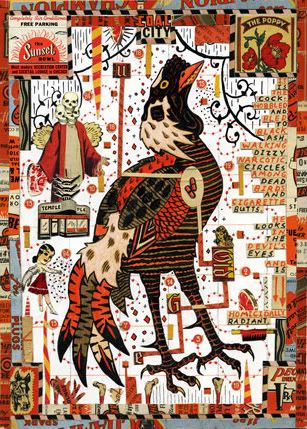
Tony Fitzpatrick
"Coal City Cock Fighter"
2009
Drawing collage
10.5 x 7.5 inches
Image credits: Tony Fitzpatrick, courtesy Dieu Donne Papermill
(Note: This post appeared concurrently on the art blog, Hungry Hyaena.)
Art Space Talk: Miles Holbert (Part 2)
 Soldier Boy by Miles Holbert
Brian Sherwin: Miles, you also create sculptural forms and installations. The Strength of 1,000 Babies and The Preservation of Intolerance captured my intention. Can you discuss these specific works and what they symbolize for you?
Miles Holbert: The strength of 1,000 Babies represents strength in numbers. Babies are naturally seen as weak and fragile. But you get a whole mess of babies and they can become overwhelming. When I look at one of the babies by itself I think “This is a cute little guy” but when I started bunching them together it became a little sinister maybe even creepy. There was definitely a shift in power from one to many. I just thought the idea of taking something that symbolizes innocence and powerlessness then giving it power buy increasing the number was an interesting idea.
The Preservation of Intolerance has to do with unwanted or haunting memories of negative events and people I have cut out of my life. I kept having dreams about these people and when I woke up I found myself thinking about them all day. Something would happen that would trigger a memory and there it would be fresh in my mind. I just made me think, that even though these events were over and that I would probably never see these people again, I would probably never get rid of these memories. That’s part of life dealing with the negative and not looking back.
 Larry Davids Biggest Fan by Miles Holbert
BS: So would you say that you adhere to a specific philosophy as far as your work is concerned? Tells us more about the thoughts behind your work… perhaps you can go into further detail about society, the concerns you have, and how those concerns are reflected in your work?
MH: I don’t follow a particular philosophy more like anything goes. I do believe that art can be used to inform, educate and transform. I also feel that as an artist and as a human being I have an obligation to try to make a positive contribution to society in some way. And that’s what I try to do.
BS: Can you discuss some of your influences? For example, are you influenced by any specific artists or art movements?
MH: I am influenced from about everything in some way or another, but I don’t subscribe to any particular movement per se. Advertising is a major influence that I can think of. As far as artist go I would definitely have to say Warhol. I live about 70 miles from the Warhol Museum in Pittsburg. As a kid I would visit the museum as much as I could. Other contemporary artist I feel influence me in many ways would be Matthew Barney ,Kris Cinalli, Matt Ritchie, Jennifer Boggess, Jeff Greenham, Sarah Maple, Richard Phillips and Kehinde Wiley.
BS: What are your thoughts concerning the internet and utilizing the World Wide Web in order to gain exposure for your art? In your opinion, why is it important for artists to embrace the internet?
MH: I live in a small town in West Virginia. There are plenty of talented artist around here. From music, to theatre and visual arts but there is virtually no exposure, the local newspaper that’s it. The internet is really the only means of getting your work out their and be able to stay in a place which I personally love. It has also exposed me to so many artists and has probably influenced my work more than I realize. Artists need to embrace the internet for the simple fact that it is building a stronger art community and creating a means of exposure.
 The More You Ignore Me The Closer I Get by Miles Holbert
BS: Do you have any concerns about the art world at this time?
MH: The major concern I have is how the recession is going to affect art. I think about how employment in the fine art fields is going to be affected and how work is going to sell.
BS: Finally, is there anything else you would like to say about your art?
MH: Thanks and I hope you enjoy my work.
This is Part 2 of my interview with Miles Holbert. To read Part 1 click, HERE
Take care, Stay true,
Brian Sherwin
Senior Editor
myartspace.com
www.myartspace.com
Myartspace Blog on Twitter
www.twitter.com/myartspace_blog
Art Space Talk: Miles Holbert (Part 1)
Miles Holbert paints portraits of rapists, killes, and pedophiles. In a sense, the portraits appear 'normal'-- they play on the viewers perception. Holbert states that he is trying to convey the idea that we as Americans are overloaded with so much stimuli that it is sometimes difficult to determine what is of importance and what is not. He goes on to say that when you view his paintings there is a killer staring you in the face, but all you can seem to concentrate on are the brightly colored flowers or the silhouettes of bunny rabbits.
Holbert was recently selected for representation at the NYAXE Gallery in Palo Alto, CA. NYAXE Gallery is a brick & mortar gallery that is managed by Catherine McCormack-Skiba, founder of www.myartspace.com. The gallery serves as a bridge between the physical and online art world.
Holbert was recently selected for representation at the NYAXE Gallery in Palo Alto, CA. NYAXE Gallery is a brick & mortar gallery that is managed by Catherine McCormack-Skiba, founder of www.myartspace.com. The gallery serves as a bridge between the physical and online art world.
 Roulette Juliet by Miles Holbert
Brian Sherwin: Miles, you were selected for representation at the NYAXE Gallery in Palo Alto, CA. As you know, NYAXE Gallery is operated by the founders of www.myartspace.com and www.nyaxe.com and serves as a way to bridge the online and physical art world. Why did you decide to submit your work for consideration?
Miles Holbert: I live in a small town with very limited avenues to display work. I wanted to introduce my work to a broader audience so I have been looking for a way to show. I then saw the NYAXE Gallery’s call for artists, thought I would take a chance.
BS: You have stated that in your work you explore how Americans are being overloaded with stimuli. Thus, in your paintings there seems to be a fight for dominance between the portrait and surrounding imagery. Can you go into further detail about that-- as well as the general message you strive to convey with your paintings?
MH: This battle is waged purposely to undermine the power of the portrait. The portrait is meant to represent certain ideals that are of importance when regarding information. There or other sources of information in the painting such as color intensity and opposition, scale, line, plants and animals. These decorations are used as a distraction from the importance or meaning of the source image.
The cultural recognition is somewhat obvious in many of my paintings such as Pigs in Zen and May God Bless You and Keep You. These portraits are easily referenced in society and can be associated with serious symbolic representation. Other paintings in this series seem less important due to the normalcy of the portrait. The face seems average and even though it is treated with iconic qualities it doesn’t achieve the same level of recognition.
Death by Color by Miles Holbert
These portraits, normal as they appear, are actually taken from mug shots of rapists, killers, and child pedophiles. I am trying to convey the idea that we as Americans are overloaded with so much stimuli that it is sometimes difficult to determine what is of importance and what is not. There is a killer staring you in the face but all you can seem to concentrate on are the brightly colored flowers or the silhouettes of bunny rabbits.
We are so heavily addicted to stimuli that we sometimes overlook what is crucial and attend to the inconsequential. I feel this goes on way to much in America. For instance when I first started this series the war in Iraq was being heavily scrutinized. Instead of our nations leaders responding to the peoples concern about our involvement in Iraq they decide to go on a crusade to clean up steroid use in professional baseball. The media coverage and press on the steroid topic overshadowed the status of the war. Some Americans were outraged and some Americans were distracted by, in my opinion, the inconsequential. The Apist by Miles Holbert
BS: Would you mind discussing one of your paintings? I’m Not Johnny perhaps?
MH: Funny story, I took this painting to class for critique and one of my class mates said “How cool, its Johnny cash! I absolutely love Johnny Cash!” I could see a slight resemblance, hair style, man in black that type of thing. I told her the only thing Johnny Cash and this guy have in common is that their both dead. I began to tell her that the gentleman in the painting was executed awhile back for multiple murders one involving a pregnant woman. Her look went from excitement to disgust in a matter of seconds.
This painting is a good example of the struggle for crucial information. It seems my classmate wanted to associate the image with a culturally iconic figure thus missing the real importance of the information. The Information is lost again.
This is Part 1 of my interview with Miles Holbert. To read Part 2 click, HERE
Take care, Stay true,
Brian Sherwin
Senior Editor
myartspace.com
www.myartspace.com
Myartspace Blog on Twitter
www.twitter.com/myartspace_blog
Tuesday, May 19, 2009
Art Space Talk: Leah Tomaino (Part 2)
 Recycled Paper Collages: Smith Mums by Leah Tomaino
This is Part 2 of my interview with Leah Tomaino. To read Part 1 click, HERE
Brian Sherwin: Tell us about your process in general. For example, do you work from nature, use reference photograph, or do you create your images in an intuitive manner?
Leah Tomaino: I do all three! I enjoy working outside during the summer months, however my camera is a very important tool to me. I take photographs as often as I have the opportunity and use my photos in my studio during the colder seasons. I start with brown grocery bags which I rip and adhere to canvas. I also paint additional bags, tear them, and then apply them to the canvas into the image of my subject.
BS: Leah, you studied at Cooper Union, William Paterson University, and abroad. Can you tell us about your academic background? Did you have any influential instructors?
LT: I studied painting during my years at The Cooper Union. I did have influential instructors, one in particular, Mr. Don Kunz. He was a painter and he also taught calligraphy. It was through the study of calligraphy that I learned of the serious discipline that is required in order to fulfill my artistic goals.
 Recycled Paper Collages: Canadaigua Lake by Leah Tomaino
BS: What about influences in general?
LT: Asian art has always been a influence on my work. I also have been greatly influenced by the American artist, Selina Trieff. I met Selina while at Cooper, for she was the mother of my good friend. I was enthralled with her work and way of life. She has been the biggest artistic influence in my life.
BS: What are your thoughts concerning the internet and utilizing the World Wide Web in order to gain exposure for your art? In your opinion, why is it important for artists to embrace the internet?
LT: The internet has been an incredibly valuable tool for exposure. I have had many opportunities presented to me that otherwise would not have happened if not for the World Wide Web. One thing tends to lead to another. It is very important to get your work out there!
BS: Do you have any concerns about the art world at this time?
LT: I am mainly concerned about the economy at this time. I am concerned that funding for important art programs for children may be cut.
LT: Asian art has always been a influence on my work. I also have been greatly influenced by the American artist, Selina Trieff. I met Selina while at Cooper, for she was the mother of my good friend. I was enthralled with her work and way of life. She has been the biggest artistic influence in my life.
BS: What are your thoughts concerning the internet and utilizing the World Wide Web in order to gain exposure for your art? In your opinion, why is it important for artists to embrace the internet?
LT: The internet has been an incredibly valuable tool for exposure. I have had many opportunities presented to me that otherwise would not have happened if not for the World Wide Web. One thing tends to lead to another. It is very important to get your work out there!
BS: Do you have any concerns about the art world at this time?
LT: I am mainly concerned about the economy at this time. I am concerned that funding for important art programs for children may be cut.
 Recycled Paper Collages: Sincerely, The Curator by Leah Tomaino
BS: Finally, is there anything else you would like to say about your art?
LT: Only that I am currently looking for gallery representation! Thank you for this wonderful opportunity!
Take care, Stay true,
Brian Sherwin
Senior Editor
myartspace.com
www.myartspace.com
Myartspace Blog on Twitter
www.twitter.com/myartspace_blog
Monday, May 18, 2009
Art Space Talk: Leah Tomaino (Part 1)
Leah Tomaino states that her work is grounded in her soul. She explains that she is taken aback by the beauty and intangible qualities of natural flora: the various textures; the amazing flowers and fruits and foliage; and most of all, the spectacular rejuvenation after what appears to be a most definite death in the bleakness of a cold, dark winter.
Furthermore, she states that in our largely urban society, the ability to appreciate our natural surroundings has become dulled-the ability to see the wonder in a tree, the magic and the mystery in a flower, the indescribable peace and contentment that can fill one’s heart. She says, “I try to show this to the viewer as my work is a surreal reminder of the peaceful, centered energy of the miraculous, natural living world which surrounds us.”
Tomaino was recently selected for representation at the NYAXE Gallery in Palo Alto, CA. NYAXE Gallery is a brick & mortar gallery that is managed by Catherine McCormack-Skiba, founder of www.myartspace.com. The gallery serves as a bridge between the physical and online art world.
 Recycled Paper Collages: Blooming Cherry by Leah Tomaino
Brian Sherwin: Leah, you were selected for representation at the NYAXE Gallery in Palo Alto, CA. As you know, NYAXE Gallery is operated by the founders of www.myartspace.com and www.nyaxe.com and serves as a way to bridge the online and physical art world. Why did you decide to submit your work for consideration?
 Recycled Paper Collages: Tyler by Leah Tomaino
 Recycled Paper Collages: Looking Up by Leah Tomaino
BS: On a philosophical or spiritual level one could suggest that your work explores the idea of life after death-- or the concept that there is something more to life than just living. Can you go into further detail about that and how it is conveyed within your work?
Furthermore, she states that in our largely urban society, the ability to appreciate our natural surroundings has become dulled-the ability to see the wonder in a tree, the magic and the mystery in a flower, the indescribable peace and contentment that can fill one’s heart. She says, “I try to show this to the viewer as my work is a surreal reminder of the peaceful, centered energy of the miraculous, natural living world which surrounds us.”
Tomaino was recently selected for representation at the NYAXE Gallery in Palo Alto, CA. NYAXE Gallery is a brick & mortar gallery that is managed by Catherine McCormack-Skiba, founder of www.myartspace.com. The gallery serves as a bridge between the physical and online art world.
Recycled Paper Collages: Blooming Cherry by Leah TomainoBrian Sherwin: Leah, you were selected for representation at the NYAXE Gallery in Palo Alto, CA. As you know, NYAXE Gallery is operated by the founders of www.myartspace.com and www.nyaxe.com and serves as a way to bridge the online and physical art world. Why did you decide to submit your work for consideration?
Leah Tomaino: I submitted my work to be reviewed because I believe that it is important to always be involved in a couple of good competitions because they offer different valuable opportunities. The NYAXE Gallery competition seemed to me to be a great competition because of the potential press coverage that the winners could receive. In addition I have been a member of www.myartspace.com for quite a long time and have found the site to be user friendly as well as having integrity.
Recycled Paper Collages: Tyler by Leah TomainoBS: You have stated that your work is a surreal reminder of natural world that surrounds us. You are concerned that the day-to-day life of urban society has dulled our perception and appreciation of nature. Can you go into further detail about that and how you strive to, in a sense, wake people up to their surroundings within your art?
LT: I find everything about nature to be fascinating. The color that surrounds us especially thrills me. For example, as I drove up to New England last Friday, I was so inspired by all the various different budding Spring greens that I found the highway to be surrounded by. There were yellow greens, emerald greens, olive greens, dark greens, white greens, hunter greens, hooker greens, sap greens…they just went on and on…and they were surrounded by beautiful hues of browns and purples that peeked through from the surrounding trees that had not yet budded.
The highway view was actually delicious! In my art I try to make the viewer be aware of just how beautiful the natural world is in terms of these naturally occurring popping colors. I think that I also wake people up when they realize that they are looking at recycled brown grocery bags!
Recycled Paper Collages: Looking Up by Leah TomainoBS: On a philosophical or spiritual level one could suggest that your work explores the idea of life after death-- or the concept that there is something more to life than just living. Can you go into further detail about that and how it is conveyed within your work?
LT: I am very interested in the possibilities of life after death. I love to work with trees as subject matter because they are a great visual symbol of death in the winter and life in the spring. Also, I find that there really is more to life than what we can see. I often choose to paint the roots of the trees as well as what we see above the ground to represent this.
This is Part 1 of my interview with Leah Tomaino. To read Part 2 click, HERE
Take care, Stay true,
Brian Sherwin
Senior Editor
myartspace.com
www.myartspace.com
Myartspace Blog on Twitter
www.twitter.com/myartspace_blog
Eva Rothschild sculpture at Tate Britain
 Mass mind (steel version) by Eva Rothschild
The Tate Britain has announced that artist Eva Rothschild will create a sculpture for the 2009 Duveens Commission. The 200 foot long sculpture will play on the idea of space and the architecture of the Duveens Galleries. The piece will no doubt play on the perception of visitors due to the fact that Duveens Galleries focus on neo-classical works of art. Thus, it will be an experience that blends old and new. The work will be on display at the Tate Britain on June 29th and will come to a close on November 29th, 2009. For more information visit, www.tate.org.uk
Saturday, May 16, 2009
Hernan Bas: The Dance of the Machine Gun & other forms of unpopular expression at Lehmann Maupin
 Mystery Bouf by Hernan Bas
The Lehmann Maupin gallery is currently exhibiting a new body of work by contemporary painter Hernan Bas. The exhibit, titled The Dance of the Machine Gun & other forms of unpopular expression, marks Bas’s first solo exhibit in over four years. A retrospective of Hernan Bas is currently on exhibit at Brooklyn Museum as well. The Brooklyn Museum Hernan Bas retrospective involves the artist’s work from the Rubell Collection of Miami. The exhibit at Lehmann Maupin will come to a close on July 10th, 2009. For more information visit, www.lehmannmaupin.com
Wednesday, May 13, 2009
The Final Deadline for London Calling Competition is now May 17th
The final deadline for the London Calling Competition has been pushed
back by 48 hours to Sunday, May 17th at 9PM PT.
Catherine McCormack-Skiba, founder and CEO of MYARTSPACE notes "The Jury will begin deliberating on Monday. We just thought it made sense to give artists the weekend to get there work in; 48 hours means a lot for those trying to tidy things up".
The juror panel includes Vanessa DesClaux (Tate Modern), Tom Morton (Hayward Gallery, Frieze Magazine), and Francesco Manacorda (Barbican Gallery). See, www.myartspace.com/londoncalling/jurors.html
Winners will have an exhibit at Scream London, a cutting-edge gallery operated by Tyrone Wood (son of Ronnie Wood of The Rolling Stones). Scream London, known for its edgy and progressive atmosphere, is located in the heart of West London’s art district. Notable guests and patrons have included Tracey Emin, Claire Danes, Rosie Huntington-Whiteley, Beverly Knight, Meg Mathews, and Ronnie Wood of The Rolling Stones.
For more information visit, www.myartspace.com/londoncalling
For a special coupon code ($25 off the entry fee) visit, www.myartspace.com/londoncalling/coupon
With the coupon code www.myartspace.com members can enter a myartspace.com gallery of 20 images for only $25. The jurors for the competition are: Vanessa DesClaux (Tate Modern), Tom Morton (Hayward Gallery, Frieze Magazine), and Francesco Manacorda (Barbican Gallery). The competition is open to artists worldwide. All mediums are accepted-- including photography, digital art, and video art.
back by 48 hours to Sunday, May 17th at 9PM PT.
Catherine McCormack-Skiba, founder and CEO of MYARTSPACE notes "The Jury will begin deliberating on Monday. We just thought it made sense to give artists the weekend to get there work in; 48 hours means a lot for those trying to tidy things up".
The juror panel includes Vanessa DesClaux (Tate Modern), Tom Morton (Hayward Gallery, Frieze Magazine), and Francesco Manacorda (Barbican Gallery). See, www.myartspace.com/londoncalling/jurors.html
Winners will have an exhibit at Scream London, a cutting-edge gallery operated by Tyrone Wood (son of Ronnie Wood of The Rolling Stones). Scream London, known for its edgy and progressive atmosphere, is located in the heart of West London’s art district. Notable guests and patrons have included Tracey Emin, Claire Danes, Rosie Huntington-Whiteley, Beverly Knight, Meg Mathews, and Ronnie Wood of The Rolling Stones.
For more information visit, www.myartspace.com/londoncalling
For a special coupon code ($25 off the entry fee) visit, www.myartspace.com/londoncalling/coupon
With the coupon code www.myartspace.com members can enter a myartspace.com gallery of 20 images for only $25. The jurors for the competition are: Vanessa DesClaux (Tate Modern), Tom Morton (Hayward Gallery, Frieze Magazine), and Francesco Manacorda (Barbican Gallery). The competition is open to artists worldwide. All mediums are accepted-- including photography, digital art, and video art.
Tuesday, May 12, 2009
Interview Magazine Copyright Infringement Controversy on Twitter and Facebook
Early this morning (May 12th, 2009) I decided to look at who some of my Twitter followers follow. While exploring Twitter I came upon the profile for Interview Magazine ( InterviewMag ). The icon image on the profile caught my eye-- it was an image of Andy Warhol that I recognized. In fact, I knew the moment I observed the icon that it was an issue of copyright infringement. I recognized the icon image and had a gut feeling that Interview Magazine-- and more importantly, Brant Publications, Inc.-- did not have rights to the image. The artist behind the image did not receive credit from Interview Magazine.


Interview Magazine used Judy Rey Wasserman's Psalm 19 (Andy Warhol) without permission.
I knew the moment I observed the Interview Magazine Twitter icon that the image was from an ink on paper portrait of Andy Warhol by Judy Rey Wasserman. I quickly contacted Wasserman ( judyrey )on Twitter in order to find out if she was aware of how the image was being used. Wasserman replied to me two hours later and confirmed that Interview Magazine had not asked permission to use her work, titled Psalm 19 (Andy Warhol), as an icon for their ‘official’ Twitter account. I stressed to Wasserman that Interview Magazine’s action was a perfect example of copyright infringement.
 Interview Magazine Copyright Infringement Controversy on Twitter and Facebook Psalm 19 (Andy Warhol) Essence series 2007, Ink on paper, 12 x 9 inches by Judy Rey Wasserman -- which can be found at www.ungravenimage.com/essence.php and www.ungravenimage.com/blog. Check it out, Interview Magazine obviously did-- and have used the image in online branding / promotional efforts without giving Wasserman credit.
Oddly enough, Judy Rey Wasserman was thrilled that Interview Magazine had used her image of Andy Warhol as the icon for their Twitter profile-- even though they had done so without permission and without giving her credit as the artist behind the image. I understood why Wasserman was excited. After all, Interview Magazine was co-founded by Andy Warhol and Wasserman happens to be an admirer of Warhol’s work.
Wasserman was excited regardless of the fact that Interview Magazine had failed to ask permission or credit her. However, I still viewed it as an issue that trampled on the rights of a fellow artist. Wasserman did not agree with my opinion on the matter-- she stated that she felt like she had been “discovered”. My point-- if it happened to her it could happen to any artist. Thus, I decided to press on.
It was soon discovered that Interview Magazine had also used Judy Rey Wasserman’s Psalm 19 (Andy Warhol) as the icon for their InterviewNews Twitter account. Further still-- the same image by Wasserman was used on Interview Magazine’s official Facebook fan page-- without permission or credit-- as a way to promote the two Twitter accounts. Obviously the person(s) behind the accounts felt that Wasserman’s image was vital to their social networking branding efforts. I had to make sure that all three accounts were officially endorsed by Interview Magazine.
 Detail from Interview Magazine's official Facebook fan page.
As it turns out, all three accounts-- the two Twitter accounts and Facebook account-- are considered ‘official’ by Interview Magazine. In other words, they are not profiles ran by fans of the publication. Someone hired by Interview Magazine was behind the choice of using Judy Rey Wasserman’s artwork 3 times without permission or credit. In fact, Interview Magazine promotes the Facebook page on the art publications official website-- and the two Twitter accounts on the Interview Magazine Facebook page.

 I contacted Interview Magazine by email in order to find out if representatives were aware that an artists work was being used in their online branding efforts without permission or credit. I stressed that I felt the action of Interview Magazine in this situation was very unethical. As I pointed out to Wasserman, would Interview Magazine allow an artist to brand his or her business with one of their magazine covers without permission-- no. Needless to say, I have yet to receive a reply from the representatives of Interview Magazine.
I wanted to give Interview Magazine and Brant Publications, Inc. the benefit of the doubt by giving them time to take action. Several hours after I contacted Interview Magazine by email action was taken-- the Twitter icons involving Judy Rey Wasserman’s artwork had been replaced by a photograph of Andy Warhol.
Obviously someone from Interview Magazine was aware of my criticism and had switched the images-- what can only be perceived as an admission of guilt. The images were removed-- however, as of this time Wasserman has yet to receive a public apology from Interview Magazine. Was Wasserman discovered by Interview Magazine? No-- her rights have been swept under the rug.

 Several hours after I contacted Interview Magazine the Twitter icons featuring Judy Rey Wasserman's Psalm 19 (Andy Warhol) were replaced by a photograph of Andy Warhol. Representatives of Interview Magazine have yet to respond to the infringement.
For those who don’t know, Brant Publications, Inc. is owned by billionaire art collector Peter Brant. Brant publishes Interview Magazine and Art in America-- one of the highest selling art magazines in the world. In my opinion, the rights of artists have really went to pot when established art magazines use images of artwork for their online promotional and branding efforts without giving credit where credit is due.
The actions of Interview Magazine (or at least the employee who maintains the Twitter and Facebook accounts) begs the question-- is this business as usual for the magazine that was co-founded by an artist who stated “good business is the best art”. In my opinion Interview Magazine has displayed very unethical behavior in handling this issue-- bad business involving an artists work and a violation of her rights.
I realize that many will say 'It is just an icon'. It was more than that-- it was a clear choice in support of the magazines online branding and promotional efforts. It was a business choice that placed the rights of an artist on the backburner. That said, I suppose it is possible that the copyright infringement controversy surrounding Interview Magazine may only last 15 minutes.
Links of Interest:
Judy Rey Wasserman’s website
www.ungravenimage.com
Links of Interest:
Judy Rey Wasserman’s website
www.ungravenimage.com
Interview Magazine
www.interviewmagazine.com
www.interviewmagazine.com
Take care, Stay true,
Brian Sherwin
Senior Editor
myartspace.com
www.myartspace.com
Myartspace Blog on Twitter
www.twitter.com/myartspace_blog
Bill Viola to receive Catalonia International Prize 2009
 BILL VIOLA - Ocean Without a Shore, 2007 3-channel High Definition Video/Sound Installation Production stills Photo: Kira Perov
James Cohan Gallery has announced that artist Bill Viola has been awarded the 2009 Catalonia International Prize. The prize, which is also known as the Premi Internacional Catalunya, was awarded to Viola by the Catalonian government of Spain.
The Catalonia International Prize is an annual award that is granted to individuals who contribute to the development of scientific, cultural or human values around the world through their creative work. The prize has existed since 1989.
Bill Viola will receive the prize from the president of the Catalan Government during a ceremony scheduled for June 30th at the Palace of the Generalitat, in Barcelona. For more informatin visit, www.jamescohan.com or www.billviola.com.
Monday, May 11, 2009
NYAXE Gallery Representation Winners. May 21, 2009 Exhibit
Congratulations to the www.myartspace.com artists selected for representation at the NYAXE Gallery. 3 artists-- Jane Fulton Alt, Leah Tomaino, and Miles Holbert, will have their work physically represented at the gallery. 17 others will be represented digitally.
 Jane Fulton Alt
 Leah Tomaino
 Miles Holbert
Jane Fulton AltNYAXE Gallery is located at 818 Emerson St. in Palo Alto, CA. The represented members were chosen from a selective-- ongoing --competition that allows members of the myartspace.com community to compete for NYAXE Gallery representation. The gallery serves as a bridge between the online and physical art world.
The NYAXE Gallery in Palo Alto, CA marks myartspace.com as one of only a few social art sites to have a physical presence in the form of a brick & mortar gallery-- as well as the only online art community to have a physical gallery presence in the heart of Silicon Valley. The NYAXE Gallery places myartspace.com members art within reach of some of the most powerful-- and wealthy-- professionals in the United States.
Leah TomainoCatherine McCormack-Skiba, Founder and CEO of myartspace, notes "It's very exciting to energize the creative spirit in Silicon Valley with world-class contemporary art. The blend of the technology innovation center of the world, and compelling art is very inspiring".
The competition is free for Premium myartspace.com members to enter. Standard members pay a $25 submission fee. Myartspace.com pays shipping expenses to and from the exhibit for artists who are selected for NYAXE Gallery representation.
The exhibit will open on May 21st . NYAXE Gallery is managed by Catherine McCormack-Skiba, the founder of www.myartspace.com and www.nyaxe.com. For more information about the winners visit, www.myartspace.com/nyaxegallery/winners.
For more information about Premium membership on myartspace.com visit, www.myartspace.com/premium. To learn about past and current myartspace.com competitions please visit, www.myartspace.com/contests.
The digitally represented artists for the May 21st NYAXE Gallery exhibit (click to view their myartspace.com profile):
Lisa Mistiuk, Edie Nadelhaft, Martin H.M Schreiber, Hans Meertens, Carla Falb, Jovan Villalba, Reka Nyari, Syed Zaman, Viviane Vives, Bill Bosler, Pau Guerrero-Prado, Bob Martin, Jagna Wesolowska, Jason Wolfe, Lucille Dweck, Thomas C Chung, Peter Tankey
To view the prior winners, February 26, 2009, click HERE.
London Calling Update
 There are only a few days left to submit art to the myartspace.com London Calling competition. The juror panel includes Vanessa DesClaux (Tate Modern), Tom Morton (Hayward Gallery, Frieze Magazine), and Francesco Manacorda (Barbican Gallery). See, www.myartspace.com/londoncalling/jurors.html
Winners will have an exhibit at Scream London, a cutting-edge gallery operated by Tyrone Wood (son of Ronnie Wood of The Rolling Stones). Scream London, known for its edgy and progressive atmosphere, is located in the heart of West London’s art district. Notable guests and patrons have included Tracey Emin, Claire Danes, Rosie Huntington-Whiteley, Beverly Knight, Meg Mathews, and Ronnie Wood of The Rolling Stones.
For more information visit, www.myartspace.com/londoncalling
For a special coupon code ($25 off the entry fee) visit, www.myartspace.com/londoncalling/coupon
With the coupon code www.myartspace.com members can enter a myartspace.com gallery of 20 images for only $25. The jurors for the competition are: Vanessa DesClaux (Tate Modern), Tom Morton (Hayward Gallery, Frieze Magazine), and Francesco Manacorda (Barbican Gallery). The competition is open to artists worldwide. All mediums are accepted-- including photography, digital art, and video art.
Subscribe to:
Posts (Atom)