So, there was a recent article on TechCrunch about this event, blending art and technology, with a lot of hyped vocabulary, click HERE for the link.
Here's the website: http://audienceconf.com/index.php
Anyone going? Tell us if you're going and what brings you there!
Wednesday, August 26, 2009

Tuesday, August 25, 2009
Reminder: Apply for our Art Scholarships! $16,000 CASH
Reminder: Be sure to apply for Art Scholarships 2009!
$16,000 CASH
It's FREE to apply!
Just register (free) and submit your work online.
Application Deadline: December 16, 2009
Apply by October 31, 2009, and get FREE PREMIUM MEMBERSHIP (more features on your MyArtSpace.com account. More info at http://www.myartspace.com/premium/)
For more info: www.myartspace.com/scholarships
$16,000 CASH
It's FREE to apply!
Just register (free) and submit your work online.
Application Deadline: December 16, 2009
Apply by October 31, 2009, and get FREE PREMIUM MEMBERSHIP (more features on your MyArtSpace.com account. More info at http://www.myartspace.com/premium/)
For more info: www.myartspace.com/scholarships
MYARTSPACE launches 7X24 streaming contemporary art channel
MYARTSPACE launches 7X24 streaming contemporary art channel
MYARTSPACE.TV
Palo Alto, CA (PRWEB) August 24, 2009 - MYARTSPACE.com, the premier online social network for the contemporary art world, has announced the launch of MYARTSPACE.tv, a site providing live, 24-hour per day streaming contemporary art and music.
Catherine McCormack-Skiba, the founder of MYARTSPACE and CEO noted "With our incredibly rich collection of contemporary art from our 60,000 artists we represent, we have a unique ability to launch rich and interesting new art services to the viewing public. MYARTSPACE.tv allows people to enjoy very high-quality, curated contemporary art in their web browser 24 hours per day. The diversity of work is also unique, with artists from over 116 countries being represented in our community."
The live streaming fine art service is combined with a music playlist constructed on Playlist.com. The service is interactive. Clicking on the art as it streams by allows art appreciators to learn more about the artist and purchase work from them.
Click on the image below to view MYARTSPACE.TV.

Brian Skiba, Chief Technology Officer at CatMacArt Corporation, the producers of the MYARTSPACE site notes "This is a first step in an interesting new direction for contemporary art, and the way in which an audience can interact. Ultimately we see specialty fine art channels being rolled out - for photography, sculpture, mixed media, painting. We also see a variety of platforms and devices from which we can leverage including high-definition television, the iPhone, and other internet-connected devices. And finally, we'll work towards availing dedicated channels for museums and galleries to offer a means of attracting a broader, younger audience to the contemporary art world.".
The streaming art service is available free at MYARTSPACE.TV.
###
About MYARTSPACE:
MYARTSPACE.com, the premier online venue for contemporary art, is one of the fastest growing and diverse communities on the internet. Its members include more than 60,000 artists, collectors, galleries and other art world professionals from across the globe, and it currently has on display hundreds of thousands of pieces of fine art. Membership is free and artist can upload their creative work including images, music and video. MYARTSPACE is created and run by CatMacArt Corporation. CatMacArt Corporation is located in Palo Alto, California. www.catmacart.com.
MYARTSPACE.TV
Palo Alto, CA (PRWEB) August 24, 2009 - MYARTSPACE.com, the premier online social network for the contemporary art world, has announced the launch of MYARTSPACE.tv, a site providing live, 24-hour per day streaming contemporary art and music.
Catherine McCormack-Skiba, the founder of MYARTSPACE and CEO noted "With our incredibly rich collection of contemporary art from our 60,000 artists we represent, we have a unique ability to launch rich and interesting new art services to the viewing public. MYARTSPACE.tv allows people to enjoy very high-quality, curated contemporary art in their web browser 24 hours per day. The diversity of work is also unique, with artists from over 116 countries being represented in our community."
The live streaming fine art service is combined with a music playlist constructed on Playlist.com. The service is interactive. Clicking on the art as it streams by allows art appreciators to learn more about the artist and purchase work from them.
Click on the image below to view MYARTSPACE.TV.
Brian Skiba, Chief Technology Officer at CatMacArt Corporation, the producers of the MYARTSPACE site notes "This is a first step in an interesting new direction for contemporary art, and the way in which an audience can interact. Ultimately we see specialty fine art channels being rolled out - for photography, sculpture, mixed media, painting. We also see a variety of platforms and devices from which we can leverage including high-definition television, the iPhone, and other internet-connected devices. And finally, we'll work towards availing dedicated channels for museums and galleries to offer a means of attracting a broader, younger audience to the contemporary art world.".
The streaming art service is available free at MYARTSPACE.TV.
###
About MYARTSPACE:
MYARTSPACE.com, the premier online venue for contemporary art, is one of the fastest growing and diverse communities on the internet. Its members include more than 60,000 artists, collectors, galleries and other art world professionals from across the globe, and it currently has on display hundreds of thousands of pieces of fine art. Membership is free and artist can upload their creative work including images, music and video. MYARTSPACE is created and run by CatMacArt Corporation. CatMacArt Corporation is located in Palo Alto, California. www.catmacart.com.
Saturday, August 15, 2009
Lowbrow Meets Highbrow
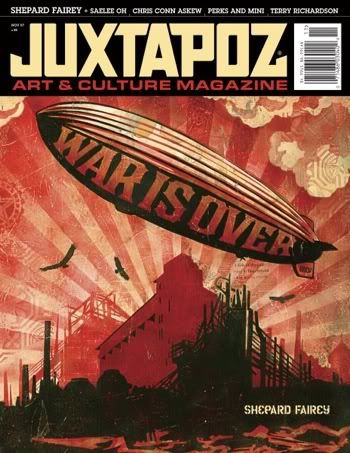
Issue of Juxtapoz Magazine
Cover art by Shepard Fairy
"A frog is either lowbrow or highbrow.In 2007, commenting on the blog PaintersNYC, artist Kelli Williams observed that it's hard to be a Juxtapoz artist "in an ArtForum world." Juxtapoz is a popular magazine dedicated to showcasing contemporary "lowbrow art." It was founded by the artist Robert Williams in 1994. The "ArtForum world" of Kelli William's statement references the magazine of that name, but also the "high art" scene it covers, of which New York City, for the time being, remains an - if not the - epicenter. Until recently, the artwork featured in ArtForum was very different from that seen in the pages of Juxtapoz. Juxtapoz is representative of the Los Angeles art scene, and the U.S. west coast scene more generally, where the aesthetics of pop surrealism, folk art, post-graffiti, or street art are wholly embraced.
If you catch it, it's low. If you order it in a French restaurant, it's high."
-Unidentified chef, from Burkhard Bilger's Noodling for Flatheads
But artwork infused by Juxtapoz's colorful spirit is no longer uncommon in New York galleries. Andrew Schoultz, Tim Biskup, and Jeff Soto, talented west coast artists regularly lauded in the pages of Juxtapoz, today exhibit with the Morgan Lehman and Jonathan Levine galleries, and influential post-graffiti artist Barry "Twist" McGee is represented by the renowned Deitch Projects. Jonathan Levine makes plain his dedication to the post-graffiti aesthetic; his gallery's website states that its mission is to exhibit "work influenced by illustration, comic books, graffiti art and pop imagery." Perhaps it's no longer so hard, then, to be a Juxtapoz artist "in an ArtForum world"?
But, more importantly, does lowbrow art require the affirmation of the "high art" world - for easy contrast, let's call it highbrow art - in order to be considered mainstream or legitimate? If so, what exactly is the cultural significance of highbrow art to the world at large?
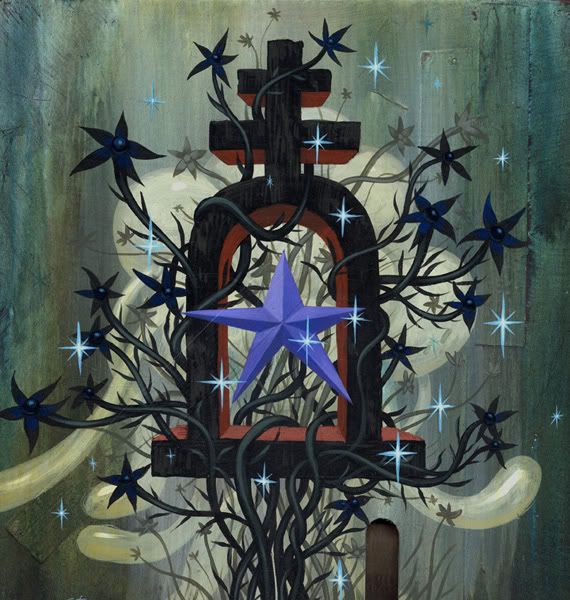
"Purple Heart"
2007
Acrylic on wood
12 x 12 inches
The commercial success of books like Beautiful Losers: Contemporary Art and Street Culture and Wall and Piece, the latest offering from the infamous British artist, Banksy, suggest that pop surrealism, post-graffiti, and street art succeed in connecting with the multitudes. On the other hand, it's an uncontroversial fact that highbrow art generally doesn't move the masses (with the exception of its remarkable ability to offend the religious sensibilities of the Christian Right and certain mayors). But highbrow art doesn't simply fail to connect with the general population; the fact is, most folks sneer at, mistrust, or resent ArtForum's world.
Perhaps because they feel beleaguered by popular tastes, many players in the world of highbrow art - artists, gallerists, critics, and curators alike - reject the influx of pop surrealism and post-graffiti flavor. But their objections will inevitably prove inconsequential; as the Borg of "Star Trek" put it, "resistance is futile." Even if some of the more esoteric subcultures of the Juxtapoz arena - Tiki culture, for example - are unlikely to find a toehold in the world of "high art," the graphic influences common to post-graffiti work already inform the paintings of contemporary art world darlings like Dana Schutz, Marcel Dzama, Trenton Doyle Hancock, Ryan McGuinness, Lisa Yuskavage, Yoshitomo Nara, and Jules de Balincourt. (In fact, Dzama and McGuinness have been featured in Juxtapoz; it won't be long before other celebrated highbrow artists are, too. One wonders if the lowbrow label will be applicable for much longer.) And then there are artists like Judith Schaechter, whose stained glass works were lauded in the pages of Juxtapoz years before her work hung in the Whitney Museum or before she received Guggenheim and National Endowment for the Arts Fellowships.
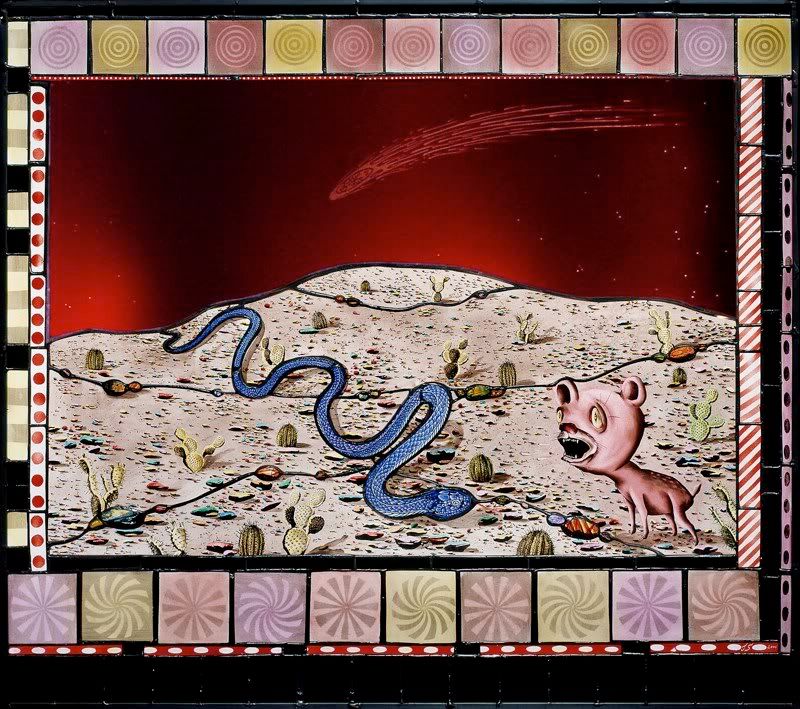
"Hyena Snake Comet"
2004-2008
Stained glass
30 x 33 inches
Much of the highbrow resistance to pop surrealism and post-graffiti is rooted in the self-identified elites' distrust of populism. Comic books and strips are intended for mass consumption, but graffiti is unquestionably the most populist of the lowbrow tributaries. No art form has fewer barriers to entry; all you need is a can of spray paint and a little chutzpah. Ask someone knowledgeable about the subject to relate the history of modern graffiti, and you'll likely hear an abridged version, one that begins in the 1970s, in and around New York City's Bronx River Houses, and runs parallel to the development of hip hop. City funding for arts and culture programs was pitifully low at the time, and enterprising teens looked for new ways to entertain and express themselves. As Lady Pink, an influential graffiti artist of the late 1970s and 1980s, explains, graffiti was the most available "forum for free speech."
Of course, the human urge to make marks predates the Bronx River Houses by millennia. Our ancestors depicted their quarry on cave walls and, more recently, citizens of ancient Rome scribbled their political opinions on market stalls (hence the word's etymology, from the Italian graffiare, meaning "to scratch or scribble.") But during the early days of modern graffiti's ascendancy, practitioners prioritized ego over observation or socio-political commentary. The pioneers of the 1970s and 1980s graffiti scenes in New York City and Philadelphia - Taki 183, StayHigh 149, Cat 161, and Cornbread, among others - were primarily known for their "tags," stylized monikers spray painted on walls and subway cars. They vied for renown by tagging as many surfaces as they could, and walls that were difficult to access had a special cache. The competitive behavior of these early graffiti "artists" might be best described as base scent marking, activity essentially indistinguishable from the industry of the bored high school student who scratches "(x) was here" on the wall of the bathroom stall. Fortunately, as more artists entered the nascent graffiti scene, such adolescent "battling" became insufficient impetus; soon, the egotistical tag evolved into something more colorful and complex. Artists added characters, often comic in nature, a result of their limited palettes and time frame, and, before long, these characters evolved into "pieces" (short for masterpieces). The best graffiti artists came to value style and artistry as much as placement.
The conceptual and social strengths of graffiti and street art are rooted in the artists' acceptance of temporality and his or her desire to engage the environment and citizenry directly. As Simon Hattenstone, a features writer for The Manchester Guardian, writes, "Since spotting my first few Banksies I have been desperately seeking out more. They make me smile and feel optimistic about the possibilities of shared dreams and common ownership." Insofar as it is truly democratic, the street artist's approach is fundamentally distinct from that of those who aspire to "high art" success. "Fine artists" are essentially aristocratic in inclination. They are the elites who operate within the context of "high art" institutions; their work is most often viewed in semi-sacred, unlived in spaces, by people who talk about the work in reverent whispers. Street art, by contrast, is viewed by everybody who happens past the artwork. But, today, as the post-graffiti movement sees many of its more celebrated artists entering the "high art" sphere, the populist flavoring of the culture is eroding.

"Balloongirl"
Artwork on West Bank barrier between Israel and the West Bank
2005
Is the aesthetic melting pot a bad thing? The answer depends on your perspective, of course; personally, I'm all for it. Like many contemporary artists, I'm not alone in feeling that my artwork and aesthetic inclinations plant a standard somewhere between the poles of Juxtapoz and ArtForum. Just as I feel torn between my rural roots and the creative community and energy of city life, so too am I drawn to elements of both art orbits, east and west, highbrow and lowbrow. I live and work in New York, so I've cultivated an appreciation for the importance of conceptual heft. But I'm also an erstwhile subscriber to Juxtapoz who, in my youth, eagerly thumbed through the pages of the Advanced Dungeons & Dragons Monster Manual, read fantasy novels and comic books, and honed my drawing chops by copying from comic strips. Perhaps I'm biased, then, but it seems that aesthetic commingling introduces hybrid vigor into otherwise "inbred" scenes.
Too many circles of the "high art" world are poisoned by intellectual pretension, obscurantism, and exclusivity. The ArtForum world is principally concerned with auction results and art historical significance. In east coast MFA programs, the mills of the contemporary "high art" world, a common question asked of students is, "Where does your work fit in the historical trajectory?" Indeed, at great cost to social legitimacy, the "high art" world has prioritized originality and artistic genealogy.
Much of the "lowbrow" scene, by contrast, is blighted by the artists' focus on disposable pop culture, their willingness to cozy up to the marketing machine, and their populist posturing. In an interview with Juxtapoz, one young artist said,
"When it comes right down to it, I draw the stuff I like, and people can take it all for whatever they want. I would say that 95 percent is liking big boobs and butts, the other five percent is brain farts that end up in a sketchbook that later ends up as a painting or whatever."Although I wrote down this quotation without recording the artist's name, I do recall appreciating some of his graphic skill. Still, when I'm confronted with such a thoughtless statement, I can appreciate the animus that brooding, theory-oriented types have for lowbrow art. Where is the evidence of this young artist's vocational mindfulness, his rigorous passion, his poetic sensibility? Of course, his defenders would likely praise his candor, but, in truth, he's posturing as much as the bespectacled, black-clad fellow who insists in his jargon-laden artist statement that Jacques Derrida informs all of his output.
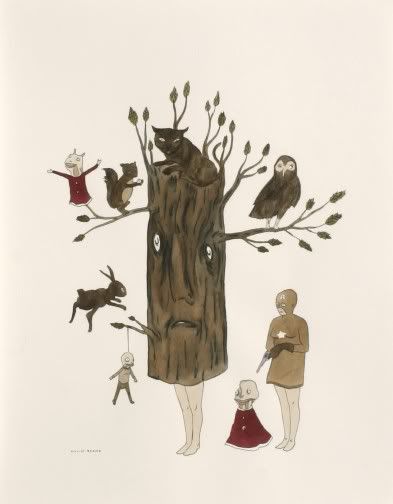
"Untitled"
2005
Watercolor on paper
14 x 11 inches
Despite haughty sneers from individuals on both sides, it seems to me that the transition that so many post-graffiti artists are making, from the streets to the galleries, could (and should) help create a less sectarian art world. The selfish pretensions of the highbrow art world could be tempered by an influx of no-nonsense, illustrative exuberance, and the lowbrow art world could jettison some of their conceptual superficiality by taking the philosophical and moral obligations of their vocation more seriously. That is, in any case, my hope.
Image credits: Juxtapoz cover image ripped from Rotofugi.com;; Jeff Soto image ripped from the Jonathan Levine Gallery website; Judith Schaechter image ripped from the artist's website; Banksy image ripped from the Brian Sewell Art Directory; Marcel Dzama image ripped from David Zwirner website
(Note: This post appeared concurrently on the art blog, Hungry Hyaena.)
Wednesday, August 12, 2009
Chinese Tradtional Art Losing Ground....
From the People's Daily Online in China...
As many young Chinese artists turn to modern art forms such as oil painting, sculpture, installation and photography, the future of traditional Chinese painting, despite its history of thousands of years, is facing a crisis, with few young people taking up the art.
See the article at:
http://english.people.com.cn/90001/90782/6725542.html
As many young Chinese artists turn to modern art forms such as oil painting, sculpture, installation and photography, the future of traditional Chinese painting, despite its history of thousands of years, is facing a crisis, with few young people taking up the art.
See the article at:
http://english.people.com.cn/90001/90782/6725542.html
Sunday, July 26, 2009
Drawing up battle lines – art gallery takes on Wikipedia
From The Independant, Andrew Johnson
The appearance of some of the world's most famous portraits on a website could create a legal landmark
In her coronation robes, Elizabeth I looks formidable and stately – the Virgin Queen in her pomp, an image to propel rivals into battle. Some 400 years after her portrait was painted, that is precisely what she has done.
Hers is one of more than 3,000 images from the National Portrait Gallery uploaded onto the free internet encyclopedia Wikipedia in April by Seattle-based Derrick Coetzee. The gallery, founded in 1856, responded last week by threatening legal proceedings against the PhD student.
That action unleashed outrage in cyberspace and quickly led to a stand-off between the proponents of free information and cultural institutions wanting to protect one of their few revenue streams – licence fees for reproducing images of their artworks. The row also goes to the heart of an internet revolution which does not recognise borders or national laws.
The gallery has instructed the law firm Farrer and Co, which represents the Queen, to sue Mr Coetzee unless the pictures are removed. They claim that letters to Wikipedia were unanswered. While the portraits are long out of copyright, the photographs are not and, the gallery argues, the digitisation process to create high resolution images has cost it around £1m. They are, they say, therefore entitled to a licence fee.
For many MYARTSPACE artists, their concern of their work showing up on commercial products and other sites without their permission (and without them getting compensated) is a valid concern.
You can read this article by clicking over to the New York Times HERE.
The appearance of some of the world's most famous portraits on a website could create a legal landmark
In her coronation robes, Elizabeth I looks formidable and stately – the Virgin Queen in her pomp, an image to propel rivals into battle. Some 400 years after her portrait was painted, that is precisely what she has done.
Hers is one of more than 3,000 images from the National Portrait Gallery uploaded onto the free internet encyclopedia Wikipedia in April by Seattle-based Derrick Coetzee. The gallery, founded in 1856, responded last week by threatening legal proceedings against the PhD student.
That action unleashed outrage in cyberspace and quickly led to a stand-off between the proponents of free information and cultural institutions wanting to protect one of their few revenue streams – licence fees for reproducing images of their artworks. The row also goes to the heart of an internet revolution which does not recognise borders or national laws.
The gallery has instructed the law firm Farrer and Co, which represents the Queen, to sue Mr Coetzee unless the pictures are removed. They claim that letters to Wikipedia were unanswered. While the portraits are long out of copyright, the photographs are not and, the gallery argues, the digitisation process to create high resolution images has cost it around £1m. They are, they say, therefore entitled to a licence fee.
For many MYARTSPACE artists, their concern of their work showing up on commercial products and other sites without their permission (and without them getting compensated) is a valid concern.
You can read this article by clicking over to the New York Times HERE.
Saturday, July 25, 2009
The art of a recession: Gallery owners struggling
SCOTTSDALE, Ariz. – Art gallery owners across the country are finding they have a tough sell these days.
With houses going up for auction, unemployment continuing to rise and the threat of layoffs seemingly ever-present, many gallery owners in art communities such as Scottsdale, Ariz., Santa Fe, N.M., Portland, Ore., and New York City are closing shop, going broke to stay open or drastically changing the way they do business.
For the full article by AMANDA LEE MYERS, Associated Press Writer, click HERE
With houses going up for auction, unemployment continuing to rise and the threat of layoffs seemingly ever-present, many gallery owners in art communities such as Scottsdale, Ariz., Santa Fe, N.M., Portland, Ore., and New York City are closing shop, going broke to stay open or drastically changing the way they do business.
For the full article by AMANDA LEE MYERS, Associated Press Writer, click HERE
Monday, July 13, 2009
New UPLOAD Manager rolling in soon
MYARTSPACE is introducing a new UPLOAD MANAGER to help make it easier for artists to upload and organize their work on the site. The goal is to deliver a better and more satisfying user experience AND to address the power needs of our premium service members.

A few points that are important to highlight on the new UPLOAD Manager:
- It provides three ways to upload images -- a "bulk loader" for the premium services members, a rapid multi-file upload for standard users, and of course the Gallery Wizard that many are historically used to using.
- Once images are selected to be uploaded, artists can apply "batch" tags to all the images at once making this much easier.
- One can upload images to an existing gallery, a new gallery, or their image library for later use.
- A new "Video Gallery" is being introduced where users can create a gallery containing just a video for playback.
- MYARTSPACE will introduce some space limitations for standard users for the first time. The aggregate amount of storage space -- including images, videos, music and voice annotation -- will be monitored and have some reasonable limitation assigned to it. Premium Subscribers will have 20GB of storage space available.
We think the introduction of the new UPLOAD manager is the first step in helping make the overall upload and management of the site better. Once we integrate this well, the "ORGANIZER" will be introduced, which allows you to manage your galleries, images, videos and work in one easy spot.

A few points that are important to highlight on the new UPLOAD Manager:
- It provides three ways to upload images -- a "bulk loader" for the premium services members, a rapid multi-file upload for standard users, and of course the Gallery Wizard that many are historically used to using.
- Once images are selected to be uploaded, artists can apply "batch" tags to all the images at once making this much easier.
- One can upload images to an existing gallery, a new gallery, or their image library for later use.
- A new "Video Gallery" is being introduced where users can create a gallery containing just a video for playback.
- MYARTSPACE will introduce some space limitations for standard users for the first time. The aggregate amount of storage space -- including images, videos, music and voice annotation -- will be monitored and have some reasonable limitation assigned to it. Premium Subscribers will have 20GB of storage space available.
We think the introduction of the new UPLOAD manager is the first step in helping make the overall upload and management of the site better. Once we integrate this well, the "ORGANIZER" will be introduced, which allows you to manage your galleries, images, videos and work in one easy spot.
Monday, June 22, 2009
Book Review: Jackie Battenfield's The Artist's Guide - How to Make a Living Doing What You Love

I was recently asked to review Jackie Battenfield's new book, The Artist's Guide - How to Make a Living Doing What You Love. It was such an excellent book that instead of reviewing it, I ended up reading the whole darn thing. Highly recommended, the following is a repost of my review at ArtLOOK:
Jackie Battenfield's new book, The Artist's Guide - How To Make a Living Doing What You Love, is an excellent resource for visual artists at any stage of their career. Battenfield writes in a professional and yet easy manner and provides invaluable information, inspiration and resources on making a successful career in the art world.
Battenfield's words do more than just dictate the "how to" and "why for" of the business end of art. She speaks from the heart and addresses such topics as knowing when you are ready to circulate your art (the difference between nurturing your artistic soul and preparing for business), how to take charge of your professional life, your marketing kit, creating your own opportunities, Introducing your work, building relationships and maintaining your practice.
This former gallery director, artist and teacher has supported herself for over 20 years through sales of her art. She and her husband (also an artist) have successfully paid the bills, purchased life insurance, funded their pension plans, took vacations and put their son through college. Jackie attributes this success to diligent planning and pursuing opportunities. She freely shares this wealth of experience and knowledge with her readers.
Inspiring quotes and advice from dozens of art world professionals are sprinkled throughout the pages providing a "reality check" for the reader. Real life examples and step by step exercises will teach you how to self promote, network, build relationships, broaden your funding resources and explore a wide range of exhibition, commission and sales opportunities beyond the walls of the traditional commercial gallery.
I highly recommend this book as someone who works on a daily basis with artists and as a graphic designer seeking opportunities for myself. Battenfield's advice was helpful and smart. The biggest praise I can give is that in reviewing the book I found a new resource which helped me help a client submit to a call for entry in NYC. This book should be on every artists desk!!
Jackie Battenfield is represented in galleries throughout the United States and in over a thousand collections worldwide. She teaches professional practices at Columbia University and for the Creative Capital Foundation. Please visit her website at www.artistcareerguide.com where you will find information on purchasing the book, interviews, events and speaking engagements.
Tuesday, June 16, 2009
Site Updates for myartspace.com
MYARTSPACE now offers a personal web address (URL) on the site for $29.99 per year or $2.99 per month as an alternative to full premium. Also, Premium Service on www.myartspace.com can now be purchased at $6.99 per month for those myartspace users that want more power, storage, and features. For a comparison of premium services versus the standard "free" subscription, see: www.myartspace.com/premium
Wednesday, June 10, 2009
Winners of the myartspace.com London Calling 2009 competition announced!
 The results of the www.myartspace.com London Calling 2009 competition have been announced. The three top winners are: Marcy Mendelson, Lydia Panas, and Davide Monaldi. The three winners will have their work physically displayed at the Scream London gallery. Seventeen competitors were chosen to be digitally represented. In all 50 finalists were selected. For more information about the London Calling finalists visit, www.myartspace.com/londoncalling/winners/
The prestigious juror panel included Vanessa DesClaux ( The Tate Modern, London), Tom Morton (Hayward Gallery, Frieze magazine), and Francesco Manacorda (Barbican Gallery, London).
More info to come.
Tuesday, June 09, 2009
Mona Hatoum at Pallazo Querini Stampalia
 Impenetrable by Mona Hatoum
The Pallazo Querini Stampalia is currently featuring a solo show of art by artist Mona Hatoum. The show, titled “Interior Landscapes”, is curated by Chiara Bertola and involves 29 works of art. The exhibit will come to a close on September 20th. For more information visit, www.querinistampalia.it/index.php
Friday, June 05, 2009
Robert Rauschenberg at Peggy Guggenheim Collection
The Peggy Guggenheim Collection in Venice is currently in the process of displaying obscure works by the late Robert Rauschenberg. The show, titled Robert Rauschenberg: Gluts, involves over forty works of art by Rauschenberg. The works explore the possibilities of metal as a medium and the social implications of metal in general. For more information visit, www.guggenheim.org/venice
Tuesday, June 02, 2009
Tighter TWITTER Integration
MYARTSPACE has just released tighter integration with TWITTER for its premium service members.
MYARTSPACE premium service members can define their twitter account (login and password), and MYARTSPACE can automatically post to TWITTER when the user creates a new gallery, posts a new blog entry, posts a new store listing on NYAXE, posts a new event/press release.

This feature is ready and available for MYARTSPACE Premium Services subscribers now.
MYARTSPACE premium service members can define their twitter account (login and password), and MYARTSPACE can automatically post to TWITTER when the user creates a new gallery, posts a new blog entry, posts a new store listing on NYAXE, posts a new event/press release.

This feature is ready and available for MYARTSPACE Premium Services subscribers now.
Personal Blogging... Coming next week to MYARTSPACE
MYARTSPACE will be introducing personal blogging for premium subscribers next week. This will allow users to create their own personal blog where they can post articles, images, galleries and movies into a free-flowing stream of thought.

Users can define set up their own visual header, define "highlighted" posts that they want featured, and post an unlimited amount. The product is closely integrated with the rest of MYARTSPACE, so they can, for instance, easily "embed" one of their galleries in the middle of their post.
We expect to roll this capability into production next week.

Users can define set up their own visual header, define "highlighted" posts that they want featured, and post an unlimited amount. The product is closely integrated with the rest of MYARTSPACE, so they can, for instance, easily "embed" one of their galleries in the middle of their post.
We expect to roll this capability into production next week.
Art Space Talk: Resa Blatman (Part 3)
This is Part 3 of my interview with Resa Blatman. To return to Part 2 click, HERE
 They Gather in Such Profusion by Resa Blatman
 Red Hot Peevish Birds by Resa Blatman
BS: Do you have any concerns about the art world at this time?
RB: As much as I am concerned about my work and it’s place within society, I try not to dwell too much on the art world. I find that getting too caught up in it only gets in the way of my work. That being said, I do think the recession is not as bad for the art world as many might think. These shifts within the economy have a way of clearing out the brush and leaving the art world to the dedicated artists who continue to make good work with serious intentions.
BS: There have been several stories involving copyright infringement in the mainstream press as of late. What is your stance on copyright? Do you see strong copyright as a reflection of artist rights in general? Or do you feel that copyright restricts creativity? Do you have a stance on this issue?
RB: My thoughts about this go back and forth. I do think it’s important for an artist to have ownership rights over their work, but I also think that we should allow others to borrow from our creations, with credit and limitations. I use photos and books for some of my source materials and without them I would have a difficult time finding the perfect ostrich, bat, or bird to paint.
 They Gather in Such Profusion by Resa Blatman
Brian Sherwin: What are your thoughts concerning the internet and utilizing the World Wide Web in order to gain exposure for your art? In your opinion, why is it important for artists to embrace the internet?
Resa Blatman: I think that it’s essential to have a web presence today. But my opinion about this may not be fully objective, as I make part of my living designing websites. However, I do believe that it’s important for anyone who wants their work to be easily and quickly accessible to have a website of some sort. It allows the audience to view anartist’s work privately, at their own pace, and without traveling -- I think this is what most people embrace about the web.
Resa Blatman: I think that it’s essential to have a web presence today. But my opinion about this may not be fully objective, as I make part of my living designing websites. However, I do believe that it’s important for anyone who wants their work to be easily and quickly accessible to have a website of some sort. It allows the audience to view anartist’s work privately, at their own pace, and without traveling -- I think this is what most people embrace about the web.
While there’s no replacement for seeing artwork in the flesh, the web can offer a personal connection with the artist and their work. Without my web presence I would not be having this interview with MyArtSpace.
BS: Will you be involved with any upcoming exhibits?
RB: Yes. I participate annually in my city’s open studios, which is one of the largest in the States. Somerville Open Studios in Massachusetts is the first weekend in May. Going on now is a small solo exhibit, “Luscious Bird Paintings,” at the Christopher Brodigan Gallery in Groton, Massachusetts until May 10th. After that, my three cut-edge triptych paintings will be on view at two juried shows in Massachusetts: Danforth Museum from June 1-August 1, 2009; and Tufts University Art Gallery, June 3-August 2, 2009.
BS: Will you be involved with any upcoming exhibits?
RB: Yes. I participate annually in my city’s open studios, which is one of the largest in the States. Somerville Open Studios in Massachusetts is the first weekend in May. Going on now is a small solo exhibit, “Luscious Bird Paintings,” at the Christopher Brodigan Gallery in Groton, Massachusetts until May 10th. After that, my three cut-edge triptych paintings will be on view at two juried shows in Massachusetts: Danforth Museum from June 1-August 1, 2009; and Tufts University Art Gallery, June 3-August 2, 2009.
Red Hot Peevish Birds by Resa BlatmanBS: Do you have any concerns about the art world at this time?
RB: As much as I am concerned about my work and it’s place within society, I try not to dwell too much on the art world. I find that getting too caught up in it only gets in the way of my work. That being said, I do think the recession is not as bad for the art world as many might think. These shifts within the economy have a way of clearing out the brush and leaving the art world to the dedicated artists who continue to make good work with serious intentions.
BS: There have been several stories involving copyright infringement in the mainstream press as of late. What is your stance on copyright? Do you see strong copyright as a reflection of artist rights in general? Or do you feel that copyright restricts creativity? Do you have a stance on this issue?
RB: My thoughts about this go back and forth. I do think it’s important for an artist to have ownership rights over their work, but I also think that we should allow others to borrow from our creations, with credit and limitations. I use photos and books for some of my source materials and without them I would have a difficult time finding the perfect ostrich, bat, or bird to paint.

BS: As you know, the economy has been hard. Have you had to change-- or should I say adapt-- your practice due to the economy?
RB: I’ve been lucky. My design business has been busier than usual lately and we have several websites that we’re currently working on, which means I have a little less time to be in the studio at the moment -- one has to work when the work is there. At the same time, I was awarded a few artist grants in the last year and sold several paintings, which has allowed me to continue working as a full-time painter.
BS: Finally, is there anything else you would like to say about your art?
RB: The ideas keep coming and I am very grateful for that.
This concludes my interview with Resa Blatman. To return to Part 1 click, HERE
Take care, Stay true,
Brian Sherwin
Senior Editor
myartspace.com
www.myartspace.com
Myartspace Blog on Twitter
www.twitter.com/myartspace_blog
Art Space Talk: Resa Blatman (Part 2)
This is Part 2 of my interview with Resa Blatman. To return to Part 1 click, HERE
 Mild Rapture #2 by Resa Blatman
 Ravishing The Night by Resa Blatman
BS: What about other influences? For example, are you influenced by any specific artists?
RB: Yes. I’m a huge fan of and influenced by many artists, particularly John Currin, Tara Donovan, Walton Ford, Julie Heffernan, Martin Johnson Heade, Ernst Haeckel, the Baroque, Hieronymus Bosch, Lucas Cranach, the Elder, early Flemish painting, Pre-Renaissance painting, the Baroque, and Victorian Decorative Art.
BS: So what is the specific message you strive to convey to viewers? Do you adhere to a specific philosophy as far as your work is concerned?
RB: As I mentioned previously, my work is specifically about fertility. This is an issue I have personal epxerience with, and one that has offered me a great deal of creative ideas and energy. I suppose my philosophy is to be honest with myself and with my audience. I can’t escape who I am, what I believe, or what I’ve experienced in my life, which means it’s impossible to divorce myself from my work. This allows me to be personal with my work and subject matter, which drives my concept. However, I do my best to keep irony within my work, and to not take myself too seriously.
 Three Flamingos by Resa Blatman
BS: What are you working on at this time? Can you give our readers some insight into your current work?
RB: If you look at my “gallery” on MyArtSpace or check out my website at http://www.resablatman.com/ you can see the cut-edge panel paintings. This is my newest work and the direction I plan to pursue for now. I’ve completed two triptych cut-edge panels (the third, “Lemon Spray,” is nearly complete), and I’m in the process of starting a fourth in this series, which will be approximately 20-30 feet wide and include six or eight panels.
To read Part 3 of my interview with Resa Blatman click, HERE
Take care, Stay true,
Brian Sherwin
Senior Editor
myartspace.com
www.myartspace.com
Myartspace Blog on Twitter
www.twitter.com/myartspace_blog
 Mild Rapture #2 by Resa Blatman
Brian Sherwin: Can you discuss your process in general? Are there any specific techniques that you utilize?
Resa Blatman: My process is quite simple. I think about my work constantly -- while I’m exercising, when I’m driving, and before I go to sleep, it’s always on my mind. For me, this is like sketching. I have a very vivid imagination; I can see what it is I want to paint before I do it. That doesn’t mean that the paintings turn out how I originally imagined them, but this process allows me to dive into a new painting without fear or hesitation. In fact, I’m often thinking about the next painting while I’m working on the current one, and that fuels me to move forward and complete the current work so that I can continue my “visual story.”
I use a lot of source materials for my paintings -- photos, books, animal, fruit, and flower models, and the internet. First, I design the surface edges on the computer and then I send the files to the company that cuts the panels. Once I have the panels back in my studio, I gather all of my source materials and I start drawing out the composition directly onto them -- there is no preliminary sketching beforehand. The painting starts off with one composition, but I frequently change the subject, placement, and color, while I’m working on it. I let myself erase, paint over, and change my mind so that the painting remains fluid despite the careful, tight rendering.
Resa Blatman: My process is quite simple. I think about my work constantly -- while I’m exercising, when I’m driving, and before I go to sleep, it’s always on my mind. For me, this is like sketching. I have a very vivid imagination; I can see what it is I want to paint before I do it. That doesn’t mean that the paintings turn out how I originally imagined them, but this process allows me to dive into a new painting without fear or hesitation. In fact, I’m often thinking about the next painting while I’m working on the current one, and that fuels me to move forward and complete the current work so that I can continue my “visual story.”
I use a lot of source materials for my paintings -- photos, books, animal, fruit, and flower models, and the internet. First, I design the surface edges on the computer and then I send the files to the company that cuts the panels. Once I have the panels back in my studio, I gather all of my source materials and I start drawing out the composition directly onto them -- there is no preliminary sketching beforehand. The painting starts off with one composition, but I frequently change the subject, placement, and color, while I’m working on it. I let myself erase, paint over, and change my mind so that the painting remains fluid despite the careful, tight rendering.
Ravishing The Night by Resa BlatmanBS: What about other influences? For example, are you influenced by any specific artists?
RB: Yes. I’m a huge fan of and influenced by many artists, particularly John Currin, Tara Donovan, Walton Ford, Julie Heffernan, Martin Johnson Heade, Ernst Haeckel, the Baroque, Hieronymus Bosch, Lucas Cranach, the Elder, early Flemish painting, Pre-Renaissance painting, the Baroque, and Victorian Decorative Art.
BS: So what is the specific message you strive to convey to viewers? Do you adhere to a specific philosophy as far as your work is concerned?
RB: As I mentioned previously, my work is specifically about fertility. This is an issue I have personal epxerience with, and one that has offered me a great deal of creative ideas and energy. I suppose my philosophy is to be honest with myself and with my audience. I can’t escape who I am, what I believe, or what I’ve experienced in my life, which means it’s impossible to divorce myself from my work. This allows me to be personal with my work and subject matter, which drives my concept. However, I do my best to keep irony within my work, and to not take myself too seriously.
Three Flamingos by Resa BlatmanBS: What are you working on at this time? Can you give our readers some insight into your current work?
RB: If you look at my “gallery” on MyArtSpace or check out my website at http://www.resablatman.com/ you can see the cut-edge panel paintings. This is my newest work and the direction I plan to pursue for now. I’ve completed two triptych cut-edge panels (the third, “Lemon Spray,” is nearly complete), and I’m in the process of starting a fourth in this series, which will be approximately 20-30 feet wide and include six or eight panels.
My plan is to keep the cut edges elaborate and have each of the panels integrate more often with one another. As for what I plan to paint, well, that’s my secret for now. Only my husband knows what I’m thinking about putting on the surface, and that may change.
To read Part 3 of my interview with Resa Blatman click, HERE
Take care, Stay true,
Brian Sherwin
Senior Editor
myartspace.com
www.myartspace.com
Myartspace Blog on Twitter
www.twitter.com/myartspace_blog
Monday, June 01, 2009
how to write an artist statement (teaser)
This is a teaser for a longer post on implicit art. Please comment there so as to keep all discussion in one place...
Like making art, there are no steadfast rules to writing artist statements - and even the best of us fail sometimes - but there are of course some decent guidelines one might consider following....
Art work descriptions and statements should be about 300 - 500 words, and strictly address the following:
7 guidelines to follow:
Read more and comment at implicit art...
Like making art, there are no steadfast rules to writing artist statements - and even the best of us fail sometimes - but there are of course some decent guidelines one might consider following....
Art work descriptions and statements should be about 300 - 500 words, and strictly address the following:
- What "is" the work? Describe it as an object, installation or situation in a way that enables visual and/or sensual comprehension. This is not what the piece is “about.” I mean it literally / physically: what are your art piece’s individual components and materials, and how do they work together as a whole?
- What do we see or experience? If it's an installation, consider a walk-through, a description of how it looks, sounds, smells, feels (again, not emotionally or conceptually, but physically), and what actions viewers have taken in and around it. If it's a situation, describe the relationships (and power structures) you are intervening in and how participants might perform them. Many works would likely need to address both what we experience and what we do as an audience or participants in front of it / around it / with it. How do viewers relate to the work, to the artist, to each other...?
- What's at stake? Why is this important to you? Why should it be important to me / others? You can briefly address or allude to conceptual issues here, but be specific rather than general. How does the piece itself address these concerns? How do we encounter them in our experience of it, and what value lies in that encounter?
7 guidelines to follow:
- This is not a mystery novel. Start with a one-sentence description that encompasses all of the above to some extent – especially what it is – then unpack each of the listed items as is needed.
Read more and comment at implicit art...
Thursday, May 28, 2009
Spring Exhibition at NYAXE Gallery in Palo Alto, CA
 Catherine McCormack-Skiba, the founder of www.myartspace.com, speaks with a NYAXE Gallery visitor.
The opening of the Spring Exhibition at NYAXE Gallery was held on May 21st. The exhibit featured works by myartspace.com members Jane Fulton Alt, Leah Tomaino, and Miles Holbert-- the finalists of the most recent NYAXE Gallery representation competition on www.myartspace.com. Seventeen artists from the myartspace.com community were represented digitally at the gallery space.
The exhibit opened at 6pm and came to a close at 10pm. A steady flow of gallery visitors were present-- over 100 people were counted during the early hours of the opening. The technology, powerful works of contemporary art, and music set the pace of the environment as cocktails were served. The event was yet another successful example of the meshing between the physical and online art world.
The exhibit opened at 6pm and came to a close at 10pm. A steady flow of gallery visitors were present-- over 100 people were counted during the early hours of the opening. The technology, powerful works of contemporary art, and music set the pace of the environment as cocktails were served. The event was yet another successful example of the meshing between the physical and online art world.
 NYAXE Gallery visitors view a work of art by Leah Tomaino
 NYAXE Gallery in Palo Alto, CA officially opened on February 26th, 2009. The exhibit on May 21st marks the second exhibit featuring www.myartspace.com members. The represented artists are chosen from a selective-- ongoing --competition that allows members of the myartspace.com community to compete for NYAXE Gallery representation. For more information visit, www.myartspace.com/nyaxegallery.
The digitally represented artists for the May 21st NYAXE Gallery exhibit:
Lisa Mistiuk, Edie Nadelhaft, Martin H.M Schreiber, Hans Meertens, Carla Falb, Jovan Villalba, Reka Nyari, Syed Zaman, Viviane Vives, Bill Bosler, Pau Guerrero-Prado, Bob Martin, Jagna Wesolowska, Jason Wolfe, Lucille Dweck, Thomas C Chung, Peter Tankey
NYAXE Gallery in Palo Alto, CA positions myartspace.com as one of only a few social art sites to have a physical presence in the form of a brick & mortar gallery-- as well as the only online art community to have a physical gallery presence in the heart of Silicon Valley. The NYAXE Gallery places myartspace.com members art within reach of some of the most powerful-- and wealthy-- professionals in the United States.
myartspace.com is the leading online social network for the contemporary art world. Dubbed "the biggest network you never heard of" by The Next Web and as one of the top six social art sites according to Mashable, the site continues to experience dramatic reception by the art community. myartspace was the first site to offer compelling, integrated presentation technology -- the ability to blend images of art, music, video and audio narration all online. The company also distinguishes itself by being a free and open community in that all members can upload an unlimited number of images, videos and music.
The competition is free for Premium myartspace.com members to enter. You can learn more about Premium membership on myartspace.com by visiting the following page, www.myartspace.com/premium. You can learn more about the current represented artists by visiting, www.myartspace.com/nyaxegallery/winners
The competition is free for Premium myartspace.com members to enter. You can learn more about Premium membership on myartspace.com by visiting the following page, www.myartspace.com/premium. You can learn more about the current represented artists by visiting, www.myartspace.com/nyaxegallery/winners
Link of Interest:
NYAXE Gallery Representation Winners. May 21, 2009 Exhibit
Claes Oldenburg at the Whitney Museum of American Art
 Ice Bag - Scale C (1971) by Claes Oldenburg via NY Times
The Whitney Museum of American Art in New York is currently featuring a Claes Oldenburg retrospective The exhibition explores Oldenburg’s early career as well as his longtime collaboration with wife Coosie van Bruggen. The retrospective details nearly five decades of Oldenburg’s work.
The sculptor is best known for his public art installations. His work tends to feature very large replicas of everyday objects. Another theme in his work is soft sculpture versions of everyday objects. The exhibit comes to a close on September 6th, 2009. For more information visit, www.oldenburgvanbruggen.com or www.whitney.org
Subscribe to:
Posts (Atom)